
Sustainability at TTSH
Our Sustainability Journey
While healthcare’s mission is to protect and promote health, it contributes significantly to the climate crisis which has a negative impact on health.
If the global healthcare sector were a country, it would be the 5th-largest emitter of greenhouse gases, responsible for 4.4% of global net emissions (Health Care Without Harm, 2019).
Given healthcare’s core mission and the ethical principle of “first, do no harm”, we must take proactive steps to mitigate the unintended environmental impact of healthcare operations.
At TTSH, we believe that caring for our patients also means caring for the planet. Our sustainability journey is rooted in our commitment to health - of people and the environment. We are dedicated to reducing our environmental footprint while continuing to deliver high-quality care, and we invite our community to join us in building a healthier, more sustainable future.
GreenGov.SG 2030 Targets
- 0% improvement in Energy Utilisation Index (EUI)
1 from 2018–2020 levels - 10% improvement in Water Efficiency Index (WEI)
2 from 2018–2020 levels - 30% improvement in Waste Disposal Index (WDI)
3 from 2022 levels - Peak public emissions around 2025
As a responsible healthcare provider, we are committed to integrating Sustainable Healthcare into every facet of our operations. This statement outlines our commitment to Sustainable Healthcare in ensuring no harm and doing what is right by our people, and our community, for generations to come.
TTSH Sustainability Framework
TTSH's Sustainability Framework outlines our key focus areas, charting the hospital's path towards sustainable healthcare delivery through cultural, infrastructural, workforce, and clinical initiatives.


Promote a culture of and inclusivity

Drive greener clinical practice & care delivery

Build resilient and sustainable infrastructure

Nurture an engaged and empowered workforce
Features
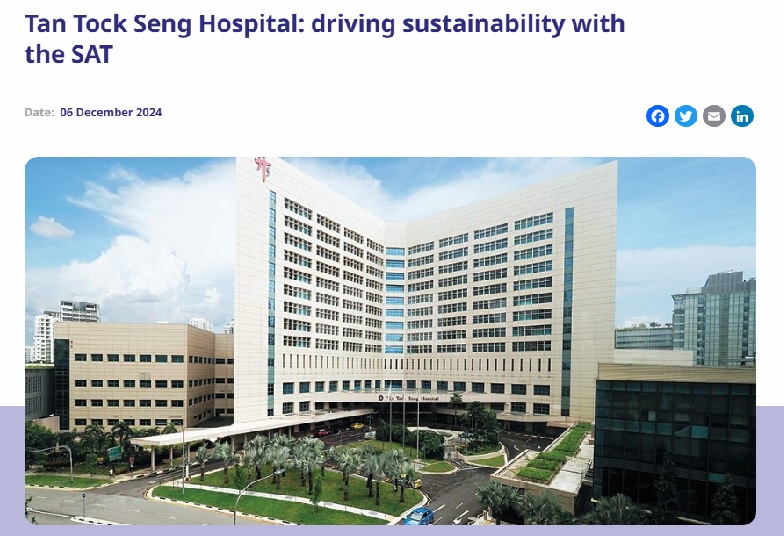
By focusing on sustainability measures to reduce carbon emissions, wastage and enhance energy savings, we continuously strive to care for the environment that we care, work and live in. We are the first acute hospital to be awarded the prestigious Building Construction Authority’s (BCA) Green Mark Platinum Super Low Energy (SLE) rating for our main building. This accolade recognises our efforts to retrofit our over 25-year-old building with innovative sustainability technologies resulting in energy efficiency improvement and minimise waste. We also bagged the BCA Health and Well-Being badge for improving the mental, physical and social well-being for our patients and staff through wellness campaigns and creating good green community spaces. Watch this video to understand how we are creating impact for a green sustainable future. #HealthforGenerations
By focusing on sustainability measures to reduce carbon emissions, wastage and enhance energy savings, we continuously strive to care for the environment that we care, work and live in. We are the first acute hospital to be awarded the prestigious Building Construction Authority’s (BCA) Green Mark Platinum Super Low Energy (SLE) rating for our main building. This accolade recognises our efforts to retrofit our over 25-year-old building with innovative sustainability technologies resulting in energy efficiency improvement and minimise waste. We also bagged the BCA Health and Well-Being badge for improving the mental, physical and social well-being for our patients and staff through wellness campaigns and creating good green community spaces. Watch this video to understand how we are creating impact for a green sustainable future. #HealthforGenerations
Tan Tock Seng Hospital was featured by Geneva Sustainability Centre (GSC) on the International Hospital Federation (IHF).
Sustainability Report 2026 and Roadmap
Through these reports and plans, we aim to provide readers with clear insights into our journey, achievements, and future direction.

Sustainability Report 2026
Download PDF

Sustainability Roadmap
Download PDF
Environmental
- Reduce our carbon footprint
- Conserve natural resources
- Promote environmental sustainability
Caring for health and the planet
At TTSH, our commitment to healing extends beyond patients — to the environment we all share. Discover how we reduce carbon emissions, champion energy-saving initiatives, embrace a circular economy, and practise green procurement to build a more sustainable healthcare future.
The first and only Singapore hospital to offer Electric Vehicle (EV) car-sharing
TTSH first introduced EV Car Sharing on 1 January 2020 at Basement 4 of our main carpark, featuring 4 BlueSG EVs. Building on this green initiative, we expanded the service and as of 12 February 2025, 3 additional BlueSG EVs are now available at the Integrated Care Hub (TTSH ICH), Basement 1 carpark.
Conversion of 10 in-house diesel vehicles to EVs, starting with shuttle buses
The diesel buses are estimated to produce 3500 kg of CO2 emission per month. With the conversion to EV, there is an expected carbon emission reduction of 50%.
Efforts to reduce Metered Dose Inhalants (MDIs) and promote use of alternatives
To minimise the environmental impact of asthma treatment, efforts were made to reduce the prescription of MDIs, which use hydrofluorocarbon (HFC) propellants. Just 100 puffs from an MDI can produce 50–80kg of CO₂ emissions, equivalent to driving up to 290km. As a greener alternative, education materials for physicians were revamped to promote inhalers that do not rely on HFCs — specifically, Dry Powder Inhalers (DPIs) and Soft Mist Inhalers (SMIs). This initiative has led to 8.2% of MDI users switching to DPIs, resulting in a carbon savings equal to nearly 600,000 km of car emissions per year.
Reduce Desflurane use and increase Sevoflurane use
Desflurane, commonly used in general anaesthesia, is a potent greenhouse gas, just one hour of use emits 30–60kg of CO₂, equivalent to a 150km drive. We have taken action by shifting toward less environmentally-harmful alternatives such as sevoflurane (15-20x less CO2/ml) and intravenous anaesthetics. Since 2017, we have achieved a 77% reduction in desflurane use, lowering our anaesthesia-related carbon footprint.
Installation of Bike Facilities
To promote sustainable commuting, we have significantly expanded our cycling infrastructure across campus. Our bicycle parking capacity has grown more than fivefold, increasing from 40 to 218 lots, complemented by repair facilities to support staff who cycle to work.
PillBot Robot (TEMi)
DPillBot robot replaces face-to-face medication counselling and dispensing to patients in high risk (‘infectious’) emergency department areas. This reduces infection risk, saving PPE (Personal Protection Equipment) doffing time for staff, and reduces the use of single-use PPE.
Annual PPE Savings: ~3,650 sets
Annual Carbon Savings: 1,825 kg CO₂e (Based on 0.5 kg CO₂e per PPE set, including manufacturing and disposal)
Optimised Temperature Settings
Temperatures within TTSH have been optimised to achieve energy efficiency (target ≥250°). Air-conditioners have scheduled operating hours, as well as eco modes that can be turned on at unoccupied premises e.g. Operating Theatres. Staff are encouraged to don heat-regulating business casual attire at work.
Carbon Savings through Telehealth
Patients with stable conditions can receive teleconsultations with their doctors. This reduces the number of trips that the patient has to make to the hospital. In CY2021-2022 alone, approximately 74,000 patient trips were saved = 142,080 kgCO2e avoided!
Reducing Energy Consumption
We are replacing our chiller plant with a more energy saving option that will cool our building more efficiently and save 4.7 million kWh of electricity consumption per year.
This is the equivalent to the electricity consumption for 860 HDB (Public Housing) flats in a year!
Energy-saving LED Lights
We switched to energy savings LED lights for the entire hospital. This reduces 1,000 tonnes of CO2 emissions a year!
TTSH Integrated Care Hub (TTSH ICH) features a roof with more than 300 solar panels that sends electricity to all the lights and power points from Level 10 to 17. The setup will generate some 120,000 kWh a year – enough to power 30 four-room HDB flats for a year – and reduces carbon emissions by 47 tonnes.
Reducing medication packaging waste via recycling
- Medication carton boxes
- Product information leaflets
- Pharma plastic bottles
- Used Ziploc bags from Pharmacy medication returns
The above were thrown into Confidential bins instead of segregation for recycling.
Recycling Pilot
Nursing, Linen, F&B, Pharmacy and Materials Management partnered with Plaspulp Union to run a recycling pilot. The trial has since extended across buildings - mTTSH, NCID, ICH and AMKSC.
From May 2024 to April 2025, a cumulative total of 2.7 ton of paper and 4.4 ton of plastic were collected.
Saying No to Single-Use Plastic Bottled Water
Plastic waste adds up, especially when single-use bottled water is used for events and daily operations. To reduce our environmental impact, our Materials Management Department has led the effort to phase out plastic bottled water and switch to carton-packaged water, which has a lower carbon footprint.
Green Procurement Guidelines
We have enhanced our procurement practices by integrating environmental factors into our tender evaluation process.
This approach enables us to make informed decisions that prioritise greener and sustainable products and solutions, ensuring our purchasing choices align with our commitment to environmental responsibility.
| Category | Description |
| Vendor company/organisation level |
|
| Vendor equipment/product level |
|
Social Sustainability: Compassion & Inclusivity
Collaborations with community volunteer welfare organizations (VWO)
Drawing from his experience as a former caregiver to his grandmother, this aspiring physiotherapist and ICH Befrienders volunteer dedicates his time to bringing warmth and companionship to our senior residents, exemplifying the compassionate spirit of our volunteer community. Meet one of our dedicated volunteers who balances a career in administration with evening volunteering at TTSH. As a Night Sitter and Pharmtastic Hero, she actively supports multiple programmes, demonstrating how working professionals can meaningfully contribute to patient care while pursuing personal growth through volunteerism.
ESG Council
In 2023, Tan Tock Seng Hospital established our Environmental, Social, and Governance (ESG) Council to lead our sustainability journey. This dedicated council oversees the development and implementation of comprehensive sustainability strategies and initiatives, reinforcing our commitment to becoming a leader in sustainable healthcare. Through this structured approach, we are transforming our operations to create lasting positive impact on both our environment and community.

