Stories & Articles
Find stories & articles about youth mental health here!
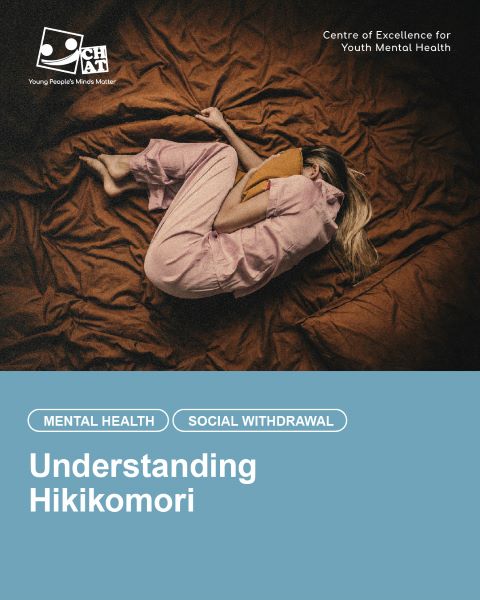
Have you ever felt so overwhelmed by the world that you just wanted to disappear into your room and never come out? For most of us, that feeling passes. However, for some youths, that feeling may linger on.
Initially seen as a Japanese societal phenomenon linked to prolonged social withdrawal (Teo & Gaw, 2010), the presence of hikikomori youths has been increasingly reported in various countries, including Singapore, as evidenced from a recent documentary, 'Shutdown' produced by Channel News Asia and released in June 2026. The documentary offered an unfiltered glimpse into the lives of youths experiencing hikikomori in Singapore: what led them to withdraw from their communities, how it affected their mental health, and what their journey in reintegrating back into society looked like. Since the airing of the documentary, it has left many people asking – what is hikikomori, and is it a mental health condition?
Contrary to popular belief, hikikomori is not a mental health condition. According to the Japanese Ministry of Health, Labour and Welfare, they define hikikomori as a condition of staying at home every day for more than 6 months with avoidance of going out or participating in society (Saito, 2010). As you can see, the official definition of hikikomori does not include mentions of any mental health conditions. This distinction matters – hikikomori describes a pattern of behaviour, not a mental health diagnosis. Still, the experiences of those living with it raise important questions: what drives someone to withdraw from society so completely, how does social withdrawal affect their mental health, and what does reintegration then look like?
It has been proposed that hikikomori is a possible response to a stressful life event (Kato et al., 2019). In the documentary, some youths pointed to experiences like bullying or frequent criticism of their academic performance as a lead-up to their withdrawal. Research has also shown that individuals experiencing hikikomori feel a sense of hopelessness, relationship fatigue and fear, to the point that it leaves them feeling like they have no other choice but to withdraw from society (Yong & Kaneko, 2016). For Singaporean youths in particular, these feelings may be compounded by the pressure to keep up in a highly competitive and collectivistic society (Liew et al., 2021). Hence, in a collectivistic society like Singapore’s, failure is rarely experienced as a personal matter alone – it can feel like rejection from one’s community and society itself (Liew et al., 2021).
While choosing to spend time alone is not inherently unhealthy, especially in a post-pandemic world where many of us have grown more comfortable with solitude, social withdrawal is different. It is often accompanied by marked distress and an impairment in functioning (Kato et al., 2024). As seen in the documentary, the youths have dropped out of school, struggled with everyday tasks, and have stopped interacting with their families. In addition to these life changes, the youths also reported experiencing feelings of anxiety towards many social aspects – from worrying about how others would judge them negatively, to fearing that history would repeat itself and they will continue to be rejected by their communities and society. Hence, the world also does not feel like a psychologically safe space to navigate for them, with some of the youths in the documentary reporting that they have difficulties trusting others, similar to past research that highlighted the feelings of distrust that youths experiencing hikikomori face towards their peers (Hattori, 2006).
Given the widespread impact that hikikomori has on one’s lives, there has been research conducted about hikikomori and its association with mental health. Hikikomori has been frequently associated with symptoms of mental health conditions such as autism (Katsuki et al., 2020), depression (Park et al., 2025), anxiety (Lin et al., 2022), addiction (Muris et al., 2023) and psychosis (Yasuma et al., 2021). In Singapore, university students with a higher risk of developing hikikomori were found to have an inverse relationship with self-esteem and well-being (Liew et al., 2021). This then creates a conundrum where individuals may be genuinely suffering, but without a clear diagnostic label, it complicates the process of receiving psychiatric support. The research community continues to debate about hikikomori and its place in mental health (Amendola, 2024). In 2022, hikikomori was included as a culturally bound syndrome in the DSM-5-TR, signalling growing recognition that it deserves more clinical attention and that greater support can be provided to hikikomori individuals.
So, what can help hikikomori youths? In Japan, the average time from the onset of withdrawal to receiving support is 4.4 years (Kondo et al., 2010, as cited in Kato et al., 2019) – and that gap is not surprising. Individuals experiencing hikikomori are unlikely to reach out for support on their own, which makes family support all the more critical in their journey towards recovery and reintegration. By being educated on hikikomori, family members can gain a better understanding on the struggles of their loved ones and link them up with professional help earlier. As shown in the documentary, there are social service agencies like Fei Yue Community Services and Impart that have dedicated workers to engage these hidden youths in Singapore, often starting with home interventions. This is encouraging as home visits have been highlighted as playing a crucial role in the early stage of support given to hikikomori individuals (Kato et al., 2019) and in subsequently increasing the motivation for social participation over time (Funakoshi et al., 2022). It is heartening to follow the journey of Zhen Yi in the documentary and to see him eventually regaining his confidence in holding his art exhibition or to see Shaista go to the gym.
If anything, the stories shared in the documentary serve as an important reminder that hikikomori is not simply about wanting to be alone. For many youths, withdrawal begins as a way of coping – a retreat from a world that feels overwhelming or unwelcoming. However, over time, what starts as a coping mechanism can quietly become something that is harder to climb out of, and a sign that there are deeper struggles that deserve attention and support.
You do not have to wait until things get worse before reaching out. If you or someone else you know have noticed similar signs/behaviours and hope to gain clarity about these concerns, that is already reason enough to seek help.
CHAT offers mental health assessments for young people aged between 16 to 30, where we have conversations with young people about their mental health and recommend appropriate avenues for support.
References:
Amendola, S. (2024). Clarifying the position of hikikomori in mental health: Is hikikomori a variant of already-known mental health disorders? A review of the literature. Journal of Pacific Rim Psychology, 18, 1 - 18. https://doi.org/10.1177/18344909241274808
Funakoshi, A., Saito, M., Yong, R., & Suzuki, M. (2022). Home visiting support for people with hikikomori (social withdrawal) provided by experienced and effective workers. The International journal of social psychiatry, 68(4), 836–843. https://doi.org/10.1177/00207640211009266
Hattori, Y. (2006). Social withdrawal in Japanese youth: A case study of thirty-five hikikomori clients. Journal of Trauma Practice, 4(3–4), 181–201. https://doi.org/10.1300/J189v04n03_0
Kato, T. A., Kanba, S., & Teo, A. R. (2019). Hikikomori : Multidimensional understanding, assessment, and future international perspectives. Psychiatry and clinical neurosciences, 73(8), 427–440. https://doi.org/10.1111/pcn.12895
Kato, T. A., Sartorius, N., & Shinfuku, N. (2024). Shifting the paradigm of social withdrawal: a new era of coexisting pathological and non-pathological hikikomori. Current opinion in psychiatry, 37(3), 177–184. https://doi.org/10.1097/YCO.0000000000000929
Katsuki, R., Tateno, M., Kubo, H., Kurahara, K., Hayakawa, K., Kuwano, N., Kanba, S., & Kato, T. A. (2020). Autism spectrum conditions in hikikomori: A pilot case-control study. Psychiatry and clinical neurosciences, 74(12), 652–658. https://doi.org/10.1111/pcn.13154
Kondo, N., Sakai, M., Kuroda, Y., Kiyota, Y., Kitabata, Y., & Kurosawa, M. (2016). General condition of hikikomori (prolonged social withdrawal) in Japan: Psychiatric diagnosis and outcome in mental health welfare centres. Int. J. Soc. Psychiatry , 59 (1). doi: 10.1177/0020764011423611
Liew, K., Uchida, Y., Dela Cruz, C., & Lee, L. N. (2021). Examining the cultural marginalisation theory of NEET/Hikikomori Risk tendencies in Singaporean youth. Psychologia, 63(1), 4–19. https://doi.org/10.2117/psysoc.2020-A120
Lin, P. K. F., Andrew, Koh, A. H. Q., & Liew, K. (2022). The relationship between Hikikomori risk factors and social withdrawal tendencies among emerging adults – An exploratory study of Hikikomori in Singapore. Frontiers in psychiatry, 13, 1065304. https://doi.org/10.3389/fpsyt.2022.1065304
Muris, P., van de Pasch, V., van Kessel, J., & Peet, J. (2023). The relationship between addiction and hikikomori tendencies: a case-control study. Frontiers in psychiatry, 14, 1273865. https://doi.org/10.3389/fpsyt.2023.1273865
Park, S. M., Joo, M. J., Lim, J. H., Jang, S.Y., Park, E.C., & Ha, M. J. (2025). Association between hikikomori (social withdrawal) and depression in Korean young adults. Journal of Affective Disorders, 380, 647–654. https://doi.org/10.1016/j.jad.2025.03.125
Saito, K. (2010) Hikikomori no hyouka: Shien ni kansuru gaidorain (Evaluation and Support Guideline for Hikikomori). Ministry of Health, Labour and Welfare, Tokyo. https://www.scirp.org/reference/referencespapers?referenceid=1653739
Teo, A. R., & Gaw, A. C. (2010). Hikikomori, a Japanese culture-bound syndrome of social withdrawal? A Proposal for DSM-V. The Journal of nervous and mental disease, 198(6), 444–449. https://doi.org/10.1097/NMD.0b013e3181e086b1
Yasuma, N., Watanabe, K., Nishi, D., Ishikawa, H., Tachimori, H., Takeshima, T., Umeda, M., & Kawakami, N. (2021). Psychotic experiences and hikikomori in a nationally representative sample of adult community residents in Japan: A cross-sectional study. Frontiers in psychiatry, 11, 602678. https://doi.org/10.3389/fpsyt.2020.602678
Yong, R. and Kaneko, Y. (2016). Hikikomori, a phenomenon of social withdrawal and isolation in young adults marked by an anomic response to coping difficulties: A qualitative study exploring individual experiences from first- and second-person perspectives. Open Journal of Preventive Medicine, 6, 1-20. doi: 10.4236/ojpm.2016.61001.
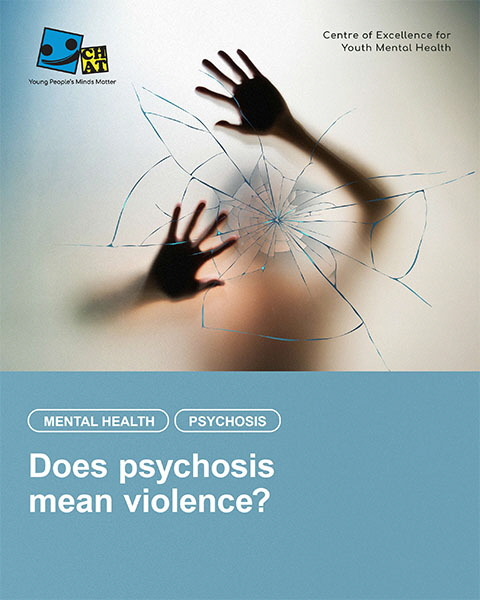
According to a news article published on 5 February 2025, a 20-year-old man was arrested for allegedly attacking several passers-by and was remanded for medical examination. A subsequent article, covering the man's sentencing, reported that he had heard voices instructing him to harm others. He was diagnosed with schizophreniform disorder, a psychotic condition that affects how a person perceives reality. The article reported that the condition was untreated at the time of the offence, and that his symptoms were considered to have contributed to his behaviour. This is not the first time news reports have linked violence with psychosis.
It is not uncommon to come across news reporting that the perpetrator of a violent act has been diagnosed with a psychotic condition. This may leave readers wondering whether psychosis always leads to violence. While cases like this receive significant public attention, it is important to understand what psychosis is – and what it is not.
Experts have consistently highlighted that the vast majority of violent crimes and mass attacks are not committed by people with psychotic conditions. When media coverage disproportionately focuses on rare and extreme cases, it can contribute to the public misunderstanding and stigma of the condition. This does not mean that risk is completely absent. Like the general population, people with psychosis may experience risk factors that increase the likelihood of harm in certain circumstances - but psychosis itself does not make someone inherently dangerous.
Symptoms that may increase distress or perceived threat
Paranoia: Some individuals with psychosis may experience changes in how they perceive reality, which can include strongly held beliefs that are not accurate. They may experience paranoia, including believing that someone is watching them, following them or even trying to harm them, even though these are not actually happening. As a result, they may feel frightened or unsafe and may behave defensively in response to perceived threats.
Command hallucinations: Some individuals with psychosis experience auditory hallucinations, where they may hear voices or sounds that others do not hear. Sometimes, these voices may give instructions or commands. The experience of hearing the voices is often distressing to the individuals. When individuals recognise that these voices are part of an illness and receive timely treatment, they are often better able to manage or ignore the voices. When symptoms are untreated and overwhelming, insight may temporarily reduce, increasing distress, difficulty coping and risk. It is important to emphasise that these experiences reflect fear and distress – not intent to harm.
Risk of violence increases when there is substance use
Research has found that the risk of violent behaviour in individuals with psychosis is strongest when there is substance abuse. It was reported that the risk of violence in individuals who have psychosis and substance abuse is similar to that in individuals who do not have psychosis but have substance abuse. Much of the observed association between psychosis and violence is therefore explained by substance use rather than psychosis itself.
Early treatment is important
Importantly, untreated symptoms of psychosis and substance use can increase distress and risk. This is why early assessment and treatment are critical. Research also shows that people with psychosis are more likely to harm themselves than others. Moreover, a substantial proportion of individuals with psychosis who exhibit violent behaviour to self or others (violent suicide attempts, major self-mutilation, homicide, assault) are those experiencing first episode psychosis (the very first time someone has psychosis), underscoring the urgency of early intervention.
Research has shown that the rate of violence is nearly two times lower after treatment is given. This indicates that appropriate treatment significantly reduces the risk of harm and improves recovery outcomes.
What you can do to help
While we might find it hard to understand what they are going through, these experiences are very real and distressing for them. Rather than dismissing or arguing with their experiences, it is more helpful to acknowledge their distress, offer reassurance, and support them to seek professional help as early as possible.
If you or someone you know is experiencing mental health concerns or showing possible signs of psychosis, you can reach out to CHAT for a confidential Mental Health Assessment and for early support.
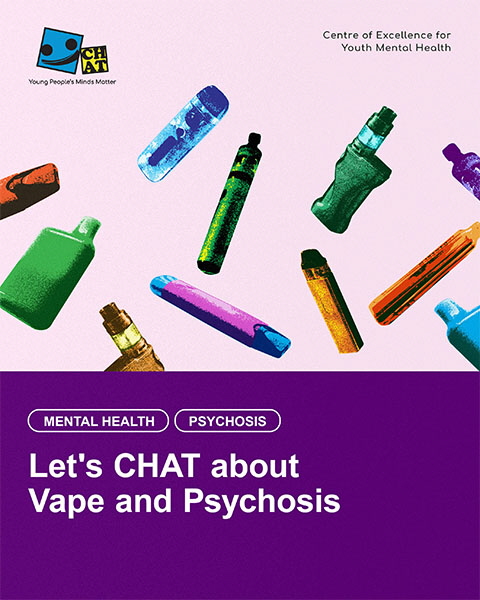
Vapes are no longer just nicotine devices. Modern vapes - whether e-cigarettes, vape pens, or K-pods - are increasingly found to be laced with dangerous substances like cannabinoids, ketamine, and etomidate that can cause psychotic symptoms such as hallucinations or paranoid thoughts. Take a student who started hearing voices and became aggressive towards teachers and was found with a vaping device. Or a young adult who believed others wanted to hurt them, threatened suicide, and attempted assault when prevented from consuming K-pods. Why would these substances trigger psychosis and what exactly is psychosis?
Psychosis is a mental health condition which affects the brain and causes a person to experience changes in thoughts, feelings and behaviour. As a result, the person cannot distinguish what is real vs and what is not.
During a psychotic episode the person experiences symptoms such as hallucinations, delusions and disorganisation, for example:
Hallucinations: Seeing, hearing, smelling, tasting, or feeling things that are not really there. For example, hearing voices that no one else can hear or seeing things that are not actually present.
Delusions: Having strong beliefs even when there is clear proof they are not true. For example, someone might believe they have special powers or that others are trying to harm them, even though there is no real evidence.
Disorganisation: When thoughts and actions become confused and mixed up, making it hard for them to communicate or do everyday tasks. For example, they might jump from one topic to another when talking, use words that do not make sense, or have trouble following simple instructions.
There are several factors that can increase the risk of someone developing psychosis, for example:
Genetics: A family member having psychosis
Stress and Trauma: High levels of stress, traumatic experiences or adverse childhood events
Social Factors: Social isolation, and socioeconomic disadvantages
Substance use: Use of drugs such as cannabis, amphetamines or hallucinogens can trigger psychosis, especially in vulnerable individuals
When people use vapes that contain drugs like etomidate, they can sometimes develop drug-induced psychosis. This means the drugs affect their brain chemicals, causing them to lose touch with reality. Imagine the brain as a busy city where messages are sent like cars on roads. The drugs can cause traffic jams or send wrong signals, making it hard for the brain to work properly. This can lead to confusion, seeing or hearing things that are not there, or feeling very scared or mixed up. These confusing experiences can happen while vaping or during withdrawal and may last from hours to several days.
While it can be frightening and disruptive to experience psychosis, support is available and you don’t need to feel alone. If you/someone you know is experiencing mental health concerns or is exhibiting signs of psychosis, reach out to CHAT for a confidential Mental Health Assessment.
For other information on cessation of vaping, visit:
Health Promotion Board (website)
National Addictions Management Service (NAMS) (website)

Let's CHAT (Real Stories from Mothers) highlights four Singaporean parents with children aged 9 to 28. They share personal stories about the emotional challenges of parenting and discussing mental health, all while striving to improve themselves daily.
How do parents navigate mental health with their children?
In this video, four Singaporean mothers open up about the emotional ups and downs of parenting — and what it really takes to start meaningful conversations at home.
Dive into 4 heartfelt stories of Singapore mums navigating their children's mental health – from teen years to adulthood. They share it all: the tough conversations, breakthrough moments, and lessons learned along the way.
Raw, honest & inspiring – these stories will touch every parent's heart.
Watch their full stories here.
Click here to download the posters (A4 size).