

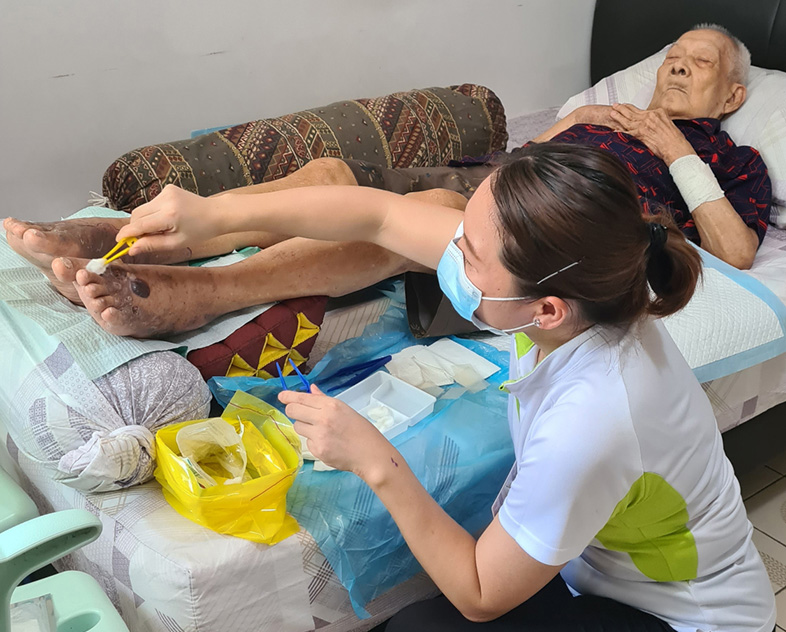
KTPH@Home is a home hospitalisation programme that offers clinically suitable patients the option of being cared for in the comfort of their own homes, instead of a hospital ward.
In The Spotlight
 AHA Magazine, Jan-Mar 2024
Delivering hospital care in the comfort of home | Video Reel
KTPH@Home |
Step 1
Emergency Department/Specialist Outpatient Clinic/Inpatient doctor identifies patients suitable for KTPH@Home. Patients can also inform their doctor on their interest in KTPH@Home.
KTPH@Home doctor review suitability.
Step 2
KTPH@Home conducts service onboarding, including cost counselling and educate patient on remote care monitoring.
Step 3
Patient discharged home with necessary medications, consumables and monitoring devices to continue treatment at home.
From home to health
Step 1
Daily clinical review and treatment (via home visit and teleconsultation); remote vital signs monitoring at home.
Step 2
Patient remains at home during recovery period.
Step 3
Discharged from KTPH@Home.
Step 4
Post discharge follow up ie. delivery of discharged medication, collection of monitoring devices, scheduling follow up appointment.
Frequently Asked Questions |
Does KTPH@Home transfer caregiver burden from hospitals to patients and their families?
While families and caregivers do take up more active roles in caring for the patient during their KTPH@Home admission, which may include assisting with activities of daily living and measuring vital signs (temperature, blood pressure, and oxygen saturations), they also enjoy some benefits.
Most of the caregivers and patients felt the programme provided comfort and convenience. Caregivers who opted for KTPH@Home felt more involved in patient care and were motivated by a sense of duty to enable their loved ones to recover in a familiar environment at home. Families and caregivers do not need to commute to visit patients at the hospital and they do not need to adhere to strict hospital visiting hours.
There are other benefits as well. Programme nurses are able to provide more targeted caregiver training and education in the patient’s home environment and assess patient self-management and caregiver competency, which are all key factors to empower patients and their caregivers to manage their own care and health.
Is KTPH@Home more expensive compared to an inpatient hospital stay?
From April 2024, MIC@Home has become a mainstream model of care in our public healthcare institutions. Charges for KTPH@Home are similar to or lower than a normal hospital ward. Patients will be supported by subsidies, MediShield Life and MediSave, no different from a physical inpatient stay.
What are the care escalation protocols if patients deteriorate at home? What happens if patients run into problems after hours?
The care team is accessible 24/7. During office hours, calls from patients are picked up by the KTPH@Home staff on duty, who would escalate to the doctor if necessary. After office hours, phone calls from patients are routed to on-call team, who would assess the situation and recommend/follow up with an appropriate action.
What happens in the event of a medical emergency?
Patients and their caregivers are educated to monitor for signs and symptoms of medical emergencies and to call 995 immediately if these are observed.
To further mitigate risks of deterioration, KTPH@Home adopts mitigation measures such as:
|

