Pathology

Introductory Message
"Anatomic pathologists play a key role in diagnosing or excluding cancer. If you are keen on using microscope, analyzing and identifying tissue patterns, leading to the diagnosis of disease, then working as a histopathologist might suit you well. Histopathology is the gold standard test of cancer diagnosis. Modern day pathologist has become the person responsible for the integration and interpretation of morphologic and molecular/ genetic information and for the delivery of critical answers to diagnostic, prognostic and predictive queries and playing absolute necessary role in the holistic patient care."
Learning Experience
Programme Faculty
What Residents Say
FAQ
Contact Details
Curriculum
The curriculum supported by TTSH Pathology department is designed to provide complete training in all major areas of anatomic pathology while remaining flexible enough to accommodate diverse career goals in clinical practice and academia.
Anatomic Pathology rotations are integrated throughout the 3-year basic curriculum leading to the intermediate examination with the United Kingdom College. This is followed by 2 additional years of advanced training, and an exit examination (United Kingdom or Australasian) leading to certification by the Singapore Accreditation Board as a specialist.
Program Mission and Aims
The mission of NHG Pathology Residency Program is to produce knowledgeable and competent pathologists who are able to deliver quality patient care that is comprehensive, appropriate and cost-effective, and be able to function effectively as leaders and members of laboratory, multidisciplinary and interprofessional teams.
The Anatomic Pathology Residency Program aims to produce clinicians who are:
Competent and safe to practise at consultant level as an Anatomic Pathologist i.e. being able to independently report routine Surgical Pathology and Cytopathology cases, as well as realise their own limitations and when to refer for further opinion
Familiar with accessioning, processing, sectioning and staining of histology and cytology material, including special techniques such as histochemistry, immunohistochemistry, immunofluorescence, electron microscopy and molecular tests, so as to be able to interact appropriately with medical technologists over those aspects of the technical work for which they are responsible. This includes possessing sufficient knowledge of laboratory procedures to be able to troubleshoot problems including issues with fixation, artefacts, staining problems, etc., so as to ensure accurate and high quality material is available for the formulation of diagnostic opinions
Skilled in management and communication in order to interact appropriately with medical, scientific, technical and clerical colleagues in the workplace, and eventually to function as a team leader, if assigned by Head of Department
Able to work well as part of a team in the delivery of appropriate aspects of healthcare services, including adaptability with administrative and management procedures needed to ensure prompt and clinically useful reporting of assigned cases as well as participation in multidisciplinary meetings
Familiar with and are able to properly manage a laboratory in terms of laboratory safety, audit and overseeing accreditation with various professional bodies. This includes being adept with health and safety regulations governing the practice of Anatomic Pathology and its subspecialties, to ensure that the working environment is safe for both themselves and their colleagues
Capable of understanding information technology sufficiently to use computers for producing pathology reports and laboratory statistics, to search databases, and to access e-mail and internet services
Able to share their knowledge to help build a living, learning and teaching organization
Experienced in performing research on surgical pathology and cytopathology material, as well as having participated in scholarly activity and able to critically appraise the medical literature
Able to take personal responsibility for their own educational and professional activities
Able to motivate themselves in acquiring new knowledge pertaining to the field of Anatomic Pathology.
Rotations
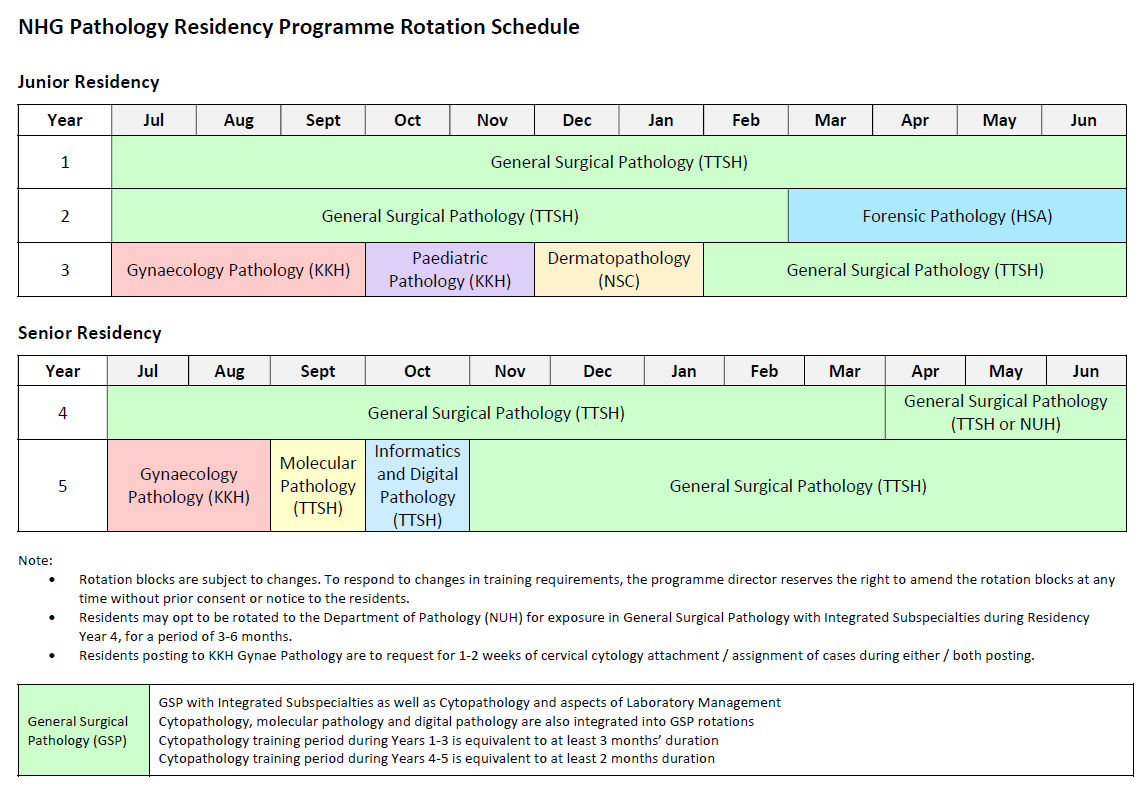
The Anatomical Pathology (AP) Program includes 60 months of structured training in General Surgical and Subspecialty Pathology, Cytopathology, Autopsy / Forensic Pathology, and aspects of Laboratory Management. Training in the first 2 years (R1 and R2) will consist of: - General Surgical Pathology, for at least 12 months - Cytopathology, which is integrated with the General Surgical Pathology rotations, for at least an equivalent of 3 months of training - Molecular pathology, which is currently undergoing integration with the General Surgical Pathology rotations, for at least an equivalent of 1 month of training - Digital pathology, which is planned to be integrated with the General Surgical Pathology rotations, for at least an equivalent of 1 month of training - Autopsy / Forensic pathology for 4 months - Gynecology pathology for 3 months and Pediatric pathology for 1 month - Dermatopathology for 1 month
Training in the third year (R3) will be geared towards consolidation of knowledge and experience acquired during the first 2 years. Apart from accruing additional experience in General Surgical Pathology which is available throughout the year, concentrated subspecialty exposure for a short duration may be made available. Those interested in research may opt to participate in the NHG Clinician-Scientist Preparatory Program (CSPP). Training may be individualised at the discretion of the Program Director depending on the timings of the previous rotations and learning needs of the resident.
Training in the fourth (R4) and fifth (R5) years will be predominantly clinical and service work based, as the resident is expected to function independently as an Anatomic Pathology Consultant upon passing of the exit examination. There will be additional external rotations for General Surgical Pathology, Gynecology Pathology and Pediatric Pathology, and another optional rotation for Dermatopathology.
Advanced Elective Rotations and Research
Apart from accruing additional experience in General Surgical Pathology which is available throughout the year, concentrated subspecialty exposure for 1-3 months may be made available. Those interested in research may opt to participate in the NHG Clinician-Scientist Preparatory Program (CSPP).
Rotation Block
Independent Study
Residents are given 12 days of training leave per year by the Ministry of Health Holdings. This time may be used for activities such as attending conferences, research activities and portfolio preparation. Residents should notify the leave dates in advance to the Programme Director so as to facilitate departmental roster planning.
Teaching Activities
Our teaching programme includes introductory lectures as well as systemic tutorials by faculty with subspecialty interests in various organ systems. This allows the resident to appreciate the breadth of diseases seen in Anatomic Pathology. However, following teaching sessions, the resident should continue reading on his/her own to gain additional knowledge. Other educational activities include participation in journal clubs, case-based discussions and multidisciplinary meetings.
Programme Director
Dr Manish Mahadeorao Bundele (TTSH)
Core Clinical Faculty Member
Dr Alexander Tang (TTSH)
Dr Irfan Sagir Khan (TTSH)
Programme Partners
KK Women's and Children's Hospital (KKH)
National University Hospital (NUH)
Health Sciences Authority (HSA)
National Skin Centre (NSC)
Woodlands Hospital (WH)