Microbiology is a five (5) year training programme that has selected the Royal College of Pathologists of Australasia (RCPA) system, which includes workplace-based assessments (WBAs), projects and examinations to support Microbiology training in Singapore. The Microbiology Programme integrates the RCPA requirements with additional Workplace-Based Assessments (WBAs). The additional WBAs include Entrustment based discussion (EbDs) that is part of the EPA system, multi-source feedback, and additional end-of-rotations reports. The final output of the RCPA system is fellowship of the college (FRCPA).
Rotations may be categorized as:
Core-general
Core-subdiscipline
Elective
There is variation amongst different sites that offer 'Core-general' training, particularly in the breadth of material/services. The design of an individual's specific rotations, along with the National Training Programme, will address this.
Healthcare Facilities for Core Postings
Core – General (Offers services in Bacteriology, Mycology, Virology)
Tan Tock Seng Hospital (TTSH) - tertiary
Singapore General Hospital (SGH) - tertiary
National University Hospital (NUH) - tertiary
Changi General Hospital (CGH)
Khoo Teck Puat Hospital (KTPH)
Ng Teng Fong General Hospital (NTFGH)
Sengkang General Hospital (SKH)
Woodlands Hospital (WH)
Core – Subdiscipline
Singapore General Hospital (Mycobacteriology / Virology)
KK Women's and Childrens' Hospital (KKH) (Paediatrics, Obstetrics & Gynaecology)
National University Hospital (Mycobacteriology, Paediatrics, Obstetrics & Gynaecology)
Opportunities for Elective Postings, awaiting official approval
National Public Health Laboratory (NPHL)
Infectious Diseases (ID)
Tuberculosis Control Unit (awaiting official approval)
DSC Clinic (awaiting official approval)
The programme is open to other proposals, subject to JCC and RCPA approval
First Year of Residency
The resident will spend time on the bench to acquire the foundational knowledge and skills in microbiology as detailed in the curriculum. Generally, residents will be rotated to tertiary institutions during this period. If the RCPA BPS exam has not yet been passed (or exemption obtained), the resident should aim to do the BPS exam in Year 1, although RCPA allow it to be taken anytime before the Part II exam. You can even take it in PGY1, before becoming a resident.
RCPA MINOR project: The minor project may be commenced after at least six months of accredited training in microbiology during Part I but is a Part II requirement i.e. completed before Part II)
RCPA MAJOR project: The major project proposal may be submitted after at least 1 year of training to the RCPA review board (but no later than 6 months after having completed the Part I examinations). The major project can only be started after the proposal has been approved. The report of the completed project may not be submitted until after successful completion of the Part I examination.
Second to Third Years of Residency
In addition to building on knowledge and skills as in Year 1, residents will be rotated to specialist institutions as necessary to achieve a broad exposure across the Microbiology curriculum. Residents will rotate to hospitals with subdiscipline areas which may not be available in all institutions (e.g. Mycobacteriology, Virology, Paediatrics, Obstetrics & Gynaecology).
Third Year of Residency
Residents are expected to take the FRCPA Part I examination in Year 2/3. As the examination includes a practical component, residents will rotate to a training site that they are most familiar with.
Fourth and Fifth Years of Residency
Residents will continue to gain experience and be expected to be proficient in knowledge and skills as detailed in the curriculum. They are expected to contribute effectively to day-to-day activities for delivering a microbiology service, with more involvement in Management, Quality and Research, noting the need for evolving RCPA projects. Rotations will include non-tertiary Core-General hospitals. They will be given opportunities to further explore subdiscipline areas or electives based on individual interests and aptitudes. Residents are expected to take the RCPA Part II examination and gain the FRCPA qualification prior to exit from residency. The Singapore SAB require residents to acquire FRCPA to be recognised as a Microbiology specialist.
Other requirements/opportunities:
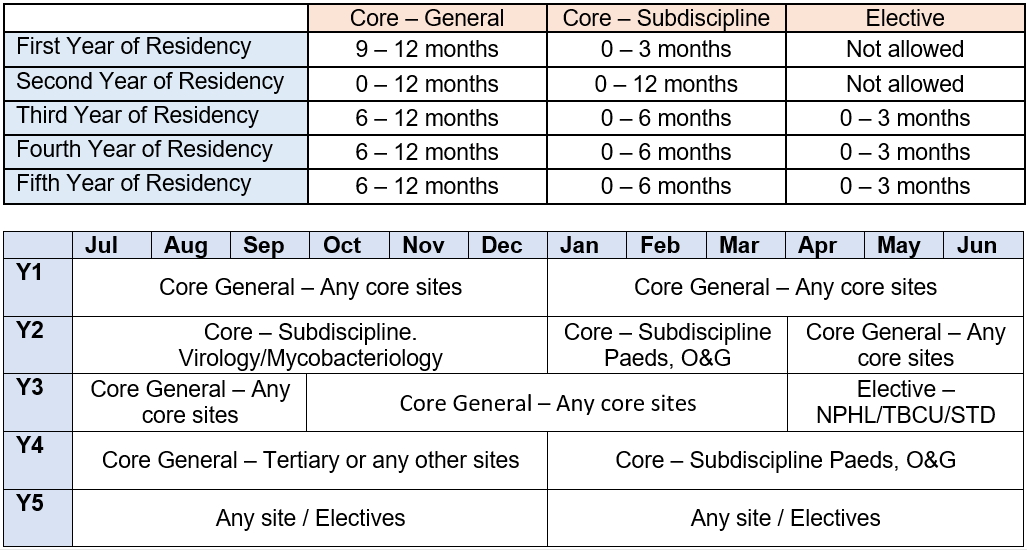
Electives rotations are encouraged for Residents with satisfactory progress. Electives are not allowed in years one and two, in order to focus on core knowledge/development. Otherwise, up to three months is allowed each year from years three to five, subject to JCC's approval.
RCPA require at least 12 months in a different institution, and MOH require at least 6 months in a different cluster. Rotations will be designed by the Residency to meet these requirements.
Example of rotations over five years
Requirements for exit
The Joint Coordinating Committee (JCC) will determine Residents' exit from training, based on review of:
Portfolio. Residents should obtain a satisfactory portfolio review anchored on Summative EPAs. All Residents must attain entrustment Level 4 [unsupervised practice allowed (distant oversight)] for all EPAs as determined by their JCC, in order to exit the programme.
FRCPA. Residents should attain FRCPA, which includes passing the Basic Pathological Sciences (BPS) exam, and RCPA Parts I and II exams.
Completion of all mandatory NHG Common Curriculum modules.