Programme & Training Structure
What is the structure of the Emergency Medicine residency?
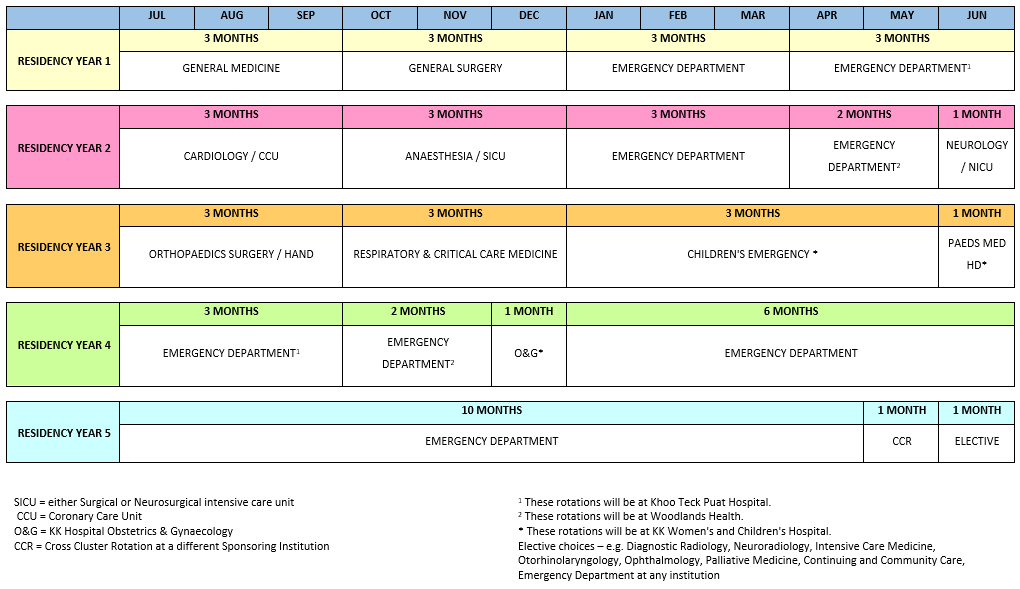
The programme is a 5-year structured residency that combines progressive clinical responsibility with formal teaching, simulation, and rotations across key specialties such as intensive care, anaesthesia, trauma, and general surgery. Training is designed to develop competence in managing undifferentiated and high-acuity patients across a wide range of clinical settings.
How does responsibility progress during training?
Residents develop from closely supervised junior clinicians to independent senior decision-makers who lead resuscitations, supervise junior residents, and coordinate care within the Emergency Department.
Clinical Exposure
Will I get enough exposure to high-acuity and resuscitation cases?
Yes. NHG Emergency Departments, particularly Tan Tock Seng Hospital (TTSH), manage a high volume of acute and complex patients, including critically ill and injured cases arriving via ambulance. TTSH is one of the busiest Emergency Departments in Singapore, with a consistently high ambulance load, providing residents with extensive exposure to resuscitation and time-critical care.
Residents gain early and repeated experience managing undifferentiated patients, trauma, cardiac emergencies, and critically ill patients in a high-volume, high-acuity environment.
Teaching & Learning Environment
What is the educational programme like?
The programme is built on a strong teaching culture, with faculty who are deeply invested in resident development. Many core faculty members hold postgraduate qualifications in medical education and are actively involved in curriculum design and delivery.
Residents benefit from a structured educational programme that includes protected teaching sessions, case-based discussions, procedural teaching, and simulation-based training. Simulation plays a key role in preparing residents for high-acuity, low-occurrence scenarios, procedural skills, and team-based crisis management.
Assessment & Support
How are residents assessed?
Residents are assessed through a combination of workplace-based assessments, structured evaluations, and formal examinations. Progress is reviewed regularly to ensure competency development.
What are the examinations that I must take?
Residents must complete the Master of Medicine (MMed) (Emergency Medicine) Part A between years 1 and 3, followed by Parts B and C by the start of year 4. In the fifth year, residents undertake an Exit Examination, comprising of a clinical viva, and a critical appraisal test. Additionally, senior residents (R4-R5) compile administrative and teaching portfolios. Our programme provides comprehensive preparation to ensure success in these assessments.
What happens if a resident is struggling?
The programme provides structured support, including mentorship, targeted feedback, and individualised remediation plans where necessary. The goal is to support every resident in achieving competency and success.
Culture & Well-being
What is the culture of the programme like?
We place strong emphasis on a supportive, team-oriented culture where residents feel safe to learn, grow, and seek help.
Support systems are built at multiple levels:
Peer support: New residents are paired with a year 2 resident to ease transition into residency
Near-peer support: Junior Chief Residents and Chief Residents play active roles in looking after resident well-being
Faculty mentorship: Residents have access to approachable and invested faculty mentors
We also run regular Balint sessions to support emotional processing and resilience, alongside social events and bonding activities to foster camaraderie within the programme.
Career Prospects and Development
What career pathways / sub-specialisations are available after residency?
Upon completing the NHG Emergency Medicine Residency Programme, residents have the opportunity to pursue sub-specialisation in various clinical domains of Emergency Medicine.
These include, but are not limited to:
Trauma: Expertise in managing acute injuries and coordinating multidisciplinary trauma care.
Toxicology: Specialised knowledge in diagnosing and treating poisonings and toxic exposures.
Emergency Geriatrics: Focused care for older adults, addressing complex medical and social needs in the emergency setting.
Pre-hospital Emergency Medicine: Proficiency in delivering emergency care outside hospital settings, including ambulance-based interventions.
Disaster Medicine: Leadership in preparing for and responding to large-scale emergencies and mass casualty incidents.
Observation Medicine: Optimising short-stay care for patients requiring extended evaluation in the Emergency Department.
Emergency Critical Care: Advanced management of critically ill patients.
Emergency Ultrasound: Mastery of point-of-care ultrasound for rapid diagnostic and procedural guidance.
Infectious Diseases: Expertise in managing acute infectious conditions, including outbreak response.
In addition to clinical sub-specialisations, many of our Emergency Physicians excel in non-clinical disciplines, offering intellectually stimulating avenues for professional growth.
These include:
Medical Education: Leading curriculum development and training for medical students, residents, and allied health professionals.
Artificial Intelligence and Medical Information Technology: Innovating healthcare delivery through AI and advanced IT solutions.
Data Science: Leveraging data analytics to improve clinical outcomes and operational efficiency.
Healthcare Quality: Driving initiatives to enhance patient safety and care standards.
Medical Law: Applying legal principles to healthcare practice, including ethics and policy development.
Research & Academic Opportunities
Are residents expected to do research?
Yes. Residents are required to complete at least one scholarly activity during residency. This may take the form of a poster presentation, oral presentation, or publication in a peer-reviewed journal.
Residents receive strong support from faculty mentors throughout the process, from project conceptualisation to presentation and publication.
Application Process
What are you looking for in applicants?
We are looking for applicants with agency, reliability, integrity, commitment and humility —individuals who can function effectively in the dynamic and often chaotic environment of the Emergency Department.
Strong candidates demonstrate:
Agency: Individuals who take ownership of their learning and growth, demonstrate initiative, and show grit in the face of challenges
Reliability: Those who are conscientious, accountable, and can be trusted to follow through on their responsibilities
Integrity: Upholding professionalism, honesty, and ethical practice at all times
Commitment: A clear dedication to training and to Emergency Medicine as a career
Humility: Self-aware individuals who are open to feedback, willing to seek help, and committed to continuous learning
Am I eligible for the programme and how do I apply?
For general queries on residency application and eligibility, please refer to this page for more information.
Choosing NHG Emergency Medicine
What differentiates NHG Emergency Medicine from other programmes?
Our programme offers broad-based training with deliberate depth in key Emergency Medicine domains.
In the junior years, residents undergo a wider range of rotations compared to other local programmes, including unique exposures such as:
• Neurology and Neuro ICU, providing strong foundations in stroke and neurocritical care
• General Surgery, developing surgical decision-making and perioperative understanding
• Urgent O&G Centre, offering hands-on experience in ambulatory gynaecological emergencies
These are complemented by high-volume clinical exposure—particularly at Tan Tock Seng Hospital, one of the busiest Emergency Departments in Singapore with a high ambulance load.
Together with a strong teaching culture, structured support systems, and simulation-based training, our programme is designed to develop well-rounded Emergency Physicians who are confident managing complex, undifferentiated patients in real-world settings.