
Diagnostic Radiology

Introduction Message
Radiologists specialise in the diagnosis of diseases based on the interpretation of medical images obtained through different imaging techniques. These techniques include X-rays, Ultrasound, MRI and CT scans. This programme aims to produce a specialist who is ready for any consultant post in the practice of clinical and academic radiology.
The NHG Diagnostic Radiology Residency Programme is a 5-year programme leading up to a specialist accreditation in Diagnostic Radiology by the Ministry of Health’s Specialist Accreditation Board.
The programme’s well-rounded and challenging training nurtures the next generation of radiologists to become experts in the practice of clinical and academic radiology. It is in our vision to produce graduates with leadership qualities, the necessary skills in leading quality improvement projects, research, teaching, and administration, in order to prepare them for any consultant post upon graduation.
The radiology departments have a long history and reputation for putting its residents through a rigorous training programme that uses a wide resource of clinical material for teaching. Nonetheless, our staff radiologists and visiting consultants who possess a complete range of subspecialty expertise will offer close guidance to each resident.
Curriculum
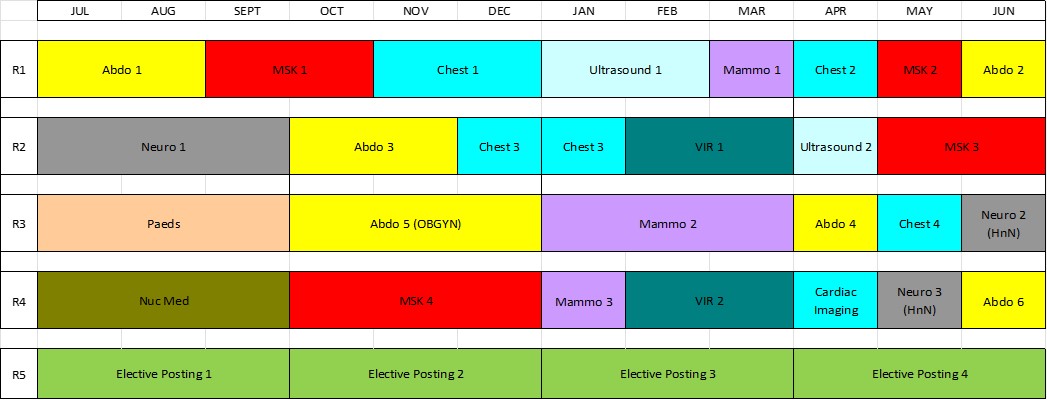
The programme is divided into five distinct phases of training, each being one year in duration:
Residency Year 1 (R1)
The R1 year is divided into two distinct halves. In the first half, the resident learns the fundamentals of plain film interpretation as well as how to perform basic fluoroscopic studies. The resident also learns basic interventional radiology procedures such as Peripherally Inserted Central Catheters (PICCs) insertion, lumbar puncture, and insertion of naso-gastric and naso-jejunal tubes under fluoroscopic guidance. The second half of R1 is a short introduction to advanced modalities such as CT, MR, and Mammography as well as practical coaching in basic Ultrasonography.
On passing the National Plain Film Exam, the resident can start doing calls. The resident’s duties involve live reporting of emergency films and some inpatient films.
Residency Year 2(R2)
The R2 year sees a transition to a subspecialty-based experience. The R2 resident will join the Thoracic and Abdominal (Body) and Musculoskeletal (MSK) teams in their daily work in CT and MRI, as well as participate in the clinico-radiological conferences and discussions with clinicians. Each R2 resident also gets a 3-month rotation to Neuro-Radiology at the National Neuroscience Institute as well as their first 2-month rotation to Vascular and Interventional Radiology (VIR).
Residency Year 3(R3)
The R3 resident begins some in-depth exposure to highly specialised rotations. These include:
Three months of Paediatic Radiology and three months of Women’s Imaging at KK Women’s and Children’s Hospital (KKH).
Three months of Breast Imaging with the breast teams at Tan Tock Seng Hospital (TTSH), Khoo Teck Puat Hospital (KTPH), or Woodlands Hospital (WH).
One month of Head and Neck Imaging.
The resident must clear the Final Fellowship Exam of the Royal College of Radiology, (FRCR) Part A examinations in R3 as part of the criteria for promotion to Senior Residency training.
Residency Year 4 (R4)
The R4 resident functions within the various subspecialty teams as a junior consultant providing consultation and advice to clinicians on various platforms. He/she does this under close supervision. Training in the R4 year centres on practical and interventional procedures. During the Breast rotation, the resident learns how to perform biopsies and how to insert localisation wires prior to surgery. During the MSK rotation, he/she learns a variety of joint injections, provocative tests, and biopsies. The R4 resident does a second 2-month rotation in VIR performing Perm Cath insertions and assisting the Interventional Radiologists in advanced procedures, like vascular stenting, embolisation and aortic stent-graft repair. He/she also does a full-time 3-month rotation to Nuclear Medicine at Singapore General Hospital (SGH). There, the resident learns Positron Emission Tomography (PET) scanning and the full range of radio-nuclide imaging.
The resident also spends one month in cardiac imaging. This posting can be done in TTSH, KTPH, WH or NUH.
Residency Year 5 (R5)
The R5 year is a purely elective year consisting of four 3-month rotations. The resident can choose to subspecialise in one particular discipline of radiology or may choose to plan his/her own refresher course in any of the disciplines. The resident would be required to perform a cross-cluster rotation to either a SingHealth or NUHS department to further broaden his/her experience. Popular rotations include Cancer Imaging at the National Cancer Centre (NCC), Paediatric Imaging at KKH, and Abdominal Imaging at SGH. The NHG Diagnostic Radiology Residency Programme ensures all residents receive the same teaching and experience.
Across the 5 years, each resident spends a portion of his/her training outside of the parent institution, TTSH, with:
- 6 months in KTPH,
- 6 months in WH,
- 6months in KKH.
- 3 months in NNI; and
- 3 months in Nuclear Medicine at SGH.
Each resident has ample opportunity to participate in overseas conferences, with funding available from MOHH and NHG.
DIDACTICS
National didactic lectures are conducted for residents 3 times a month from the R1 to R4 years. All residents will be provided protected time off to attend the lectures. The national didactics are also supplemented by in-house department teaching events in the radiology departments of TTSH, KTPH and WH. The departments at KKH, NNI, SGH Nuclear Medicine, and NUH would also have their own department teaching events to supplement our residents’ learning.
EXAMINATIONS
The resident needs to clear the MMed (DR)/ Final FRCR examinations before he/she enters the R5 year.
Programme Director
Dr Low Hsien Min (TTSH)
Associate Programme Directors
Dr Ong Chern Yue Glen (TTSH)
Dr Ong Yu Xuan Nicholas (WH)
Dr Dinesh Singh Rambachan (KTPH)
Clinical Core Faculty Members
Dr Daniel Wong En Shen (TTSH)
Dr Ankit Tandon (TTSH)
Dr Glen Ong Chern Yue (TTSH)
Dr Justin Kwan (TTSH)
Dr Lee Yeong Shyan (TTSH)
Dr Hollie Lim Mei Yeen (TTSH)
Dr Kwok Christine (TTSH)
Dr Chan Gabriel (TTSH)
Dr Leong Ying Xin Candice (TTSH)
Dr Khoo Hau Wei (TTSH)
Dr Peter Choo Zhi Qing (TTSH)
Dr Wong Mei Ping Pearlyn (TTSH)
Dr Chong Jingli (TTSH)
Dr Dinesh Rambachan Singh (KTPH)
Dr Chou Hong (KTPH)
Dr Paul See Poh Lye (KTPH)
Dr Dinesh Chinchure (KTPH)
Dr Shikhare Sumer Nrupendra (KTPH)
Dr Darren Chan Kin-Tak (KTPH)
Dr Tan Hsien Khai (KTPH)
Dr Lim Tze Chwan (WH)
Dr Ong Yu Xuan Nicholas (WH)
Dr Loh Eu Kuang Stanley (WH)
Dr Low Tze-Anns Keynes (WH)
Dr Mary Liang Moon-Sun (WH)
Dr Mukherjee Pratik (WH)
“As a rapidly advancing field, radiology keeps me engaged and fulfilled as I am able to provide an essential role in advocating for efficient and individualised treatment plans. Training in the NHG Radiology residency programme has helped me to grow as a critical thinker and self-directed learner, all whilst fostering a spirit of camaraderie which makes the work we do even more enjoyable.”
– Dr Lim Yi Ting, Senior Resident
“In the dynamic world of healthcare, Radiology stands as a beacon of innovation, seamlessly integrating the latest technological advancements like Artificial Intelligence with the timeless principles of medicine. To me, this specialty represents the perfect intersection of these two fields. This, together with its unparalleled clinical diversity with a diverse range of conditions across all ages and demographics, ensures a dynamic and enriching learning journey every day. To this end, the NHG Radiology residency program is a crucible of learning in this exciting field, providing a nurturing environment where knowledge and experiences are shared freely, making it not just a profession but a passion.”
- Dr Goh Shu Wen, Alumni, Associate Consultant, Tan Tock Seng Hospital, Department of Diagnostic Radiology
“An indispensable component of modern medicine, Radiology is always at the forefront of technological change in our constant pursuit to image human anatomy and pathology in greater detail. The residency program offers a conducive learning environment, and uses a robust and multifaceted training approach to equip me with all the necessary skill sets to excel as a clinical radiologist."
- Dr Alexander Yap, Alumni, Consultant, Woodlands Hospital, Department of Radiology
“I chose Radiology because Anatomy has always been my favourite subject since Medical School. Every patient presents uniquely and Radiology allows me to combine using visuospatial skills and technology to reach a definitive diagnosis, so I can aid my clinical colleagues in effecting the relevant treatment for the patient. I like to think of us as the silent workers supporting our fellow colleagues, doing what we can in the best way we know how. At the end of the day, we all only have one aim - the ultimate good for our patients."
- Dr Nicole Kessa Wee, Alumni, Consultant, Tan Tock Seng Hospital, Department of Diagnostic Radiology
“Driven by new technology, Radiology is in-demand and ever-changing. Whether it's computed tomography, magnetic resonance, interventional radiology or artificial intelligence, Radiology plays a critical role in the diagnosis and treatment of diseases. NHG Radiology Residency programme prepares us to be independent learners and forward thinkers, ready to face the challenges ahead."
- Dr Terrence Hui, Alumni, Consultant, Tan Tock Seng Hospital, Department of Diagnostic Radiology
What kind of assessments and examinations can I expect in residency?
Residents undergo regular formative assessments throughout their residency to ensure continuous learning and skill development. These assessments include the Mini-Clinical Evaluation Exercise (Mini-CEX) and Direct Observation of Procedural Skills (DOPS). The Mini-CEX involves residents performing specific clinical tasks, such as protocoling and reporting radiology studies, or chairing a multidisciplinary team meeting, under direct observation by a supervisor, who then provides feedback on their performance. DOPS focuses on procedural skills, where residents are observed performing procedures to assess their competence and technique. Both types of assessments aim to identify areas of strength and areas needing improvement, helping residents refine their clinical and procedural skills over time, and also help to assign entrustment levels for Entrustable Professional Activities (EPAs).
All residents must take the National Plain Film examination approximately six months after starting R1. Additionally, passing the FRCR examinations is crucial for advancing in the residency program. Progression to R3 requires passing the FRCR Part 1 examinations, while progression to R4 and R5 necessitates passing the Final FRCR 2A and FRCR 2B, respectively.
What EPAs are there in Radiology Residency?
Radiology has 7 EPAs:
EPA1: Reporting of Radiographs (X-rays)
EPA2: Performing Basic Image-guided Interventional procedures
EPA3: Protocoling and reporting MRI scans
EPA4: Protocoling and reporting CT scans
EPA5: Performing and reporting US studies
EPA6: Performing Fluoroscopy Procedures
EPA7: Reporting of Mammogram and Breast Ultrasound scans
Residents will need to attain entrustment level 5 (able to supervise others) for EPA1 and level 4 (remote supervision) for the other EPAs by the end of residency.
Is there a scholarly activity component which is required for the successful completion of Residency?
From the AY24 intake onwards, all residents will be required to complete a 3-part scholarly activity by the end of residency. The 3-part scholarly activity consists of the following:
Completion of an educational module on research methods
Completion of 4 Critically Appraised Topics (CATs)
Completion of a research proposal
How do I increase my chances of being accepted into the NHG Residency Programme?
Interested applicants should establish email contact with the Programme Director, telling the director of his/her interest. This email should contain a CV with a passport-sized photograph. MOPEX rotations in a radiology department is recommended, but not a compulsory requirement for entry into the programme. Our programme highly values clinical experience in ED, General Surgery, Orthopaedic Surgery, Urology, and General Medicine.
What are the programme's selection criteria for residency application?
Please view the selection criteria here:
Selection_Criteria_NHG DR.pdf
Am I eligible for the programme and how do I apply?
For general queries on residency application and eligibility, please refer to this page for more information.
For more information on the NHG Diagnostic Radiology Residency Programme, please contact:

Programme Director
Dr Low Hsien Min
Senior Consultant, Department of Diagnostic Radiology
Tan Tock Seng Hospital
Programme Coordinator
Ms Angeline Huang (Point of Contact)
Ms Lee Hui Ling Adeline

