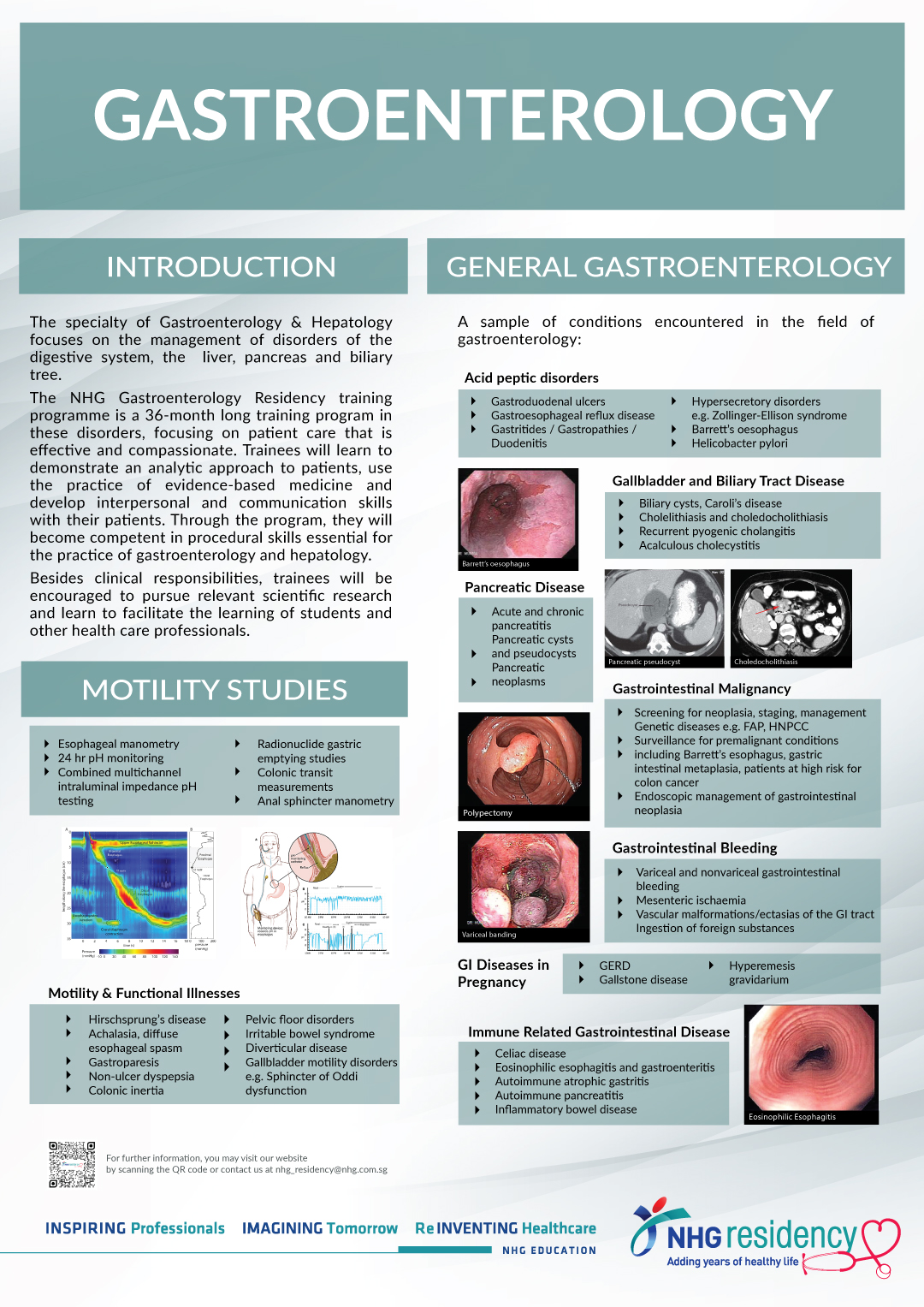
Gastroenterology is an internal medicine-related specialty that manages acutely or chronically ill patients with a diverse range of gastrointestinal and liver diseases. This programme provides the resident with a rich educational and training experience to become a competent gastroenterologist.
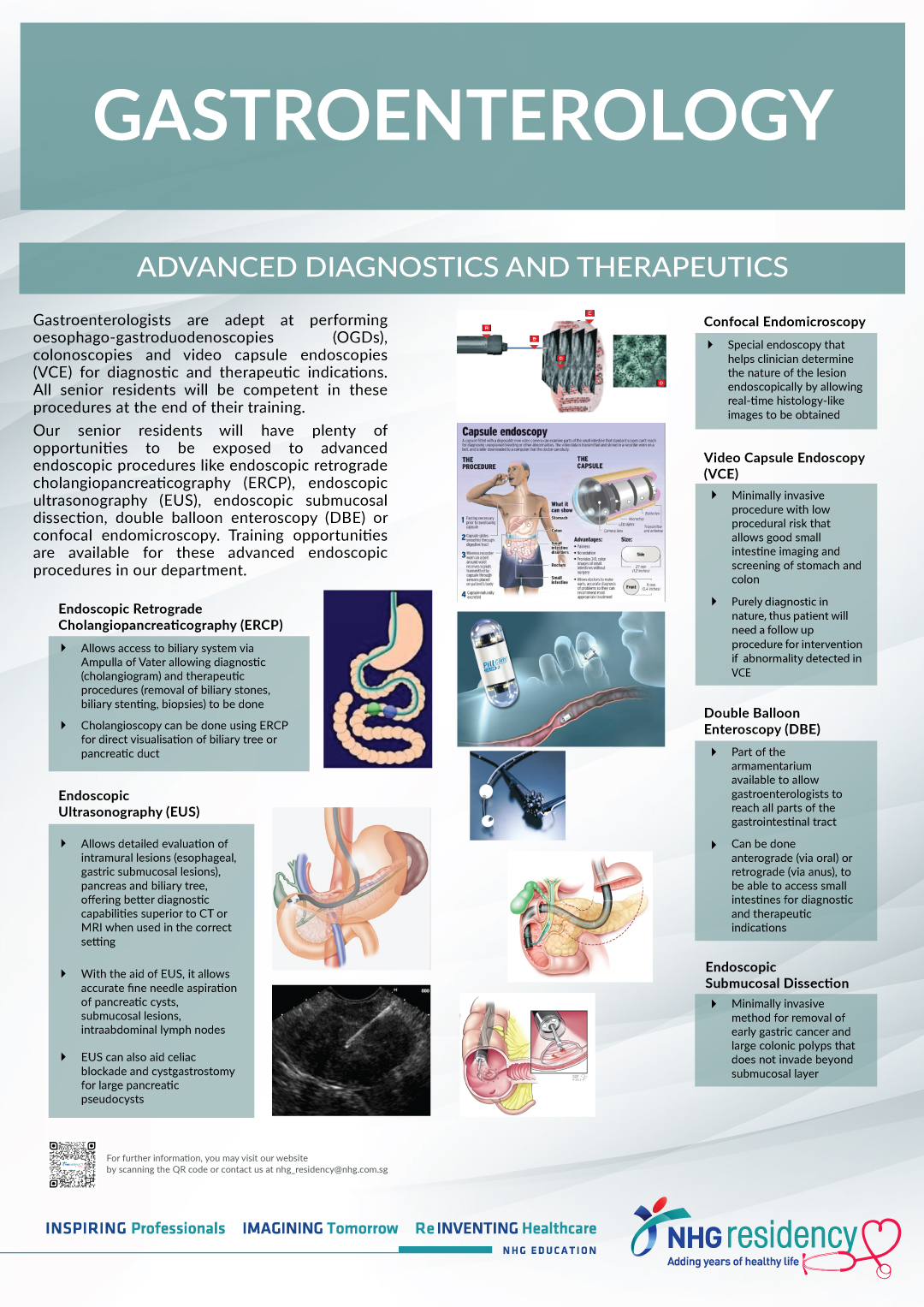
The NHG Gastroenterology Residency Programme is a 3-year training programme that offers the resident a dynamic career upon graduation. Gastroenterology is exciting and challenging, as it combines the fulfilment of diagnosing gastrointestinal (GI) and liver diseases with the excitement of performing diagnostic and therapeutic endoscopy. These procedures include oesophagogastroduodenoscopy, colonoscopy, enteroscopy, capsule endoscopy, endoscopic ultrasound (EUS), and endoscopic retrograde cholangiopancreatography (ERCP). Although Gastroenterology is a rapidly advancing specialty, our department fulfils the training needs of our senior residents through performing thousands of endoscopic procedures yearly.
The resident can expect to learn from a dedicated and experienced team of gastroenterologists who helms the programme. These faculty members subspecialise in advanced therapeutic GI endoscopy, upper GI motility, inflammatory bowel disease, nutrition, and hepatology. Our strong tradition of teaching excellence creates a highly supervised environment for the resident to train in. We implement a structured training programme that ensures the resident achieves the core competencies and curriculum requirements.
Additionally, the vast clinical resources at Tan Tock Seng Hospital (TTSH) and Khoo Teck Puat Hospital (KTPH) offer a wide case-mix that the resident can learn from. With the aim to produce gastroenterologists who are compassionate and competent in the management of a wide variety of gastrointestinal and liver disorders, our programme provides the resident a holistic training experience so he/she can acquire the skills, knowledge, and attitudes to become an excellent gastroenterologist.
Learning Experience
Programme Faculty
What Residents Say
FAQ
Contact Details
Curriculum
The NHG Gastroenterology Residency Programme is a 3-year training programme that consists of fixed and elective rotations in TTSH and KTPH. In the first and second year, the resident will rotate to inpatient service, specialty clinics, inpatient consult service, nutrition service, endoscopy, and motility service. In addition, the resident will have the opportunity to rotate to National University Hospital for exposure in liver transplantation in his/her third year of training.
In the programme, the resident will learn and manage the acutely ill gastroenterology patients who are admitted to the wards, participate in the running of supervised specialty clinics that handle hepatology, motility, and inflammatory bowel disease, and run personal general gastroenterology clinics. He/she will also provide inpatient consult service, participate in nutritional multidisciplinary rounds, achieve competency in procedures such as diagnostic and therapeutic oesophagogastroduodenoscopy and colonoscopy. These involve hemostasis techniques and polypectomy. The resident will also learn to insert and change percutaneous endoscopic gastrostomy tubes, and perform and interpret capsule endoscopy. Besides these, he/she also has the opportunity to observe liver biopsy, motility studies, and advance endoscopic techniques such as oesophageal dilatation, EUS and ERCP.
The resident must embark on a research project in the first year and present his/her findings at a local or regional conference by the second or third year.
By the end of the training, our programme ensures that each resident will attain the skills, knowledge, and attitudes to be competent in managing a wide spectrum of gastrointestinal diseases. They include acid peptic-related problems, common functional GI and motility disorders, liver diseases, complications of cirrhosis, biliary and pancreatic diseases, common GI infections and non-infectious GI luminal diseases, common GI and liver malignancies. The resident will also be competent in assessing a patient's nutritional status and implement nutritional therapies, perform endoscopic procedures to evaluate and manage GI bleeding, and perform upper and lower endoscopic evaluation of the GI tract for screening, diagnosis and intervention.
Upon successfully completing the Residency Programme, the resident will have opportunities for subspecialty training in motility, nutrition, inflammatory bowel disease, hepatology, and advanced endoscopy.
Rotations
In the first and second year of training, the resident will rotate to TTSH or KTPH for the following modules:
a. Inpatient Ward Service and Specialty Outpatient Clinic module
b. Nutrition Service and Inpatient Consult Service module
c. Endoscopy and Motility Service module
In the third year of training, in addition to the above modules, the resident will rotate to National University Hospital for a 6-week liver transplantation module.
In each year of training, the resident will rotate to a 2-month GM and/or GRM posting, as mandated by the Specialist Accreditation Board (SAB) of Singapore.
Teaching Activities
The resident must participate actively in the programme's teaching programme, including weekly core curriculum teaching, grand ward rounds, journal clubs, radiology conferences, histopathology conferences, and hepatopancreaticobiliary conferences. In addition, the resident will have opportunities to participate in the education of medical students, junior residents, medical officers, and other allied health groups.