Overview
The normal human eye produces a certain amount of tears for adequate lubrication of the surface of the eye. The tears will need to be drained normally into the tear drainage system. However, sometimes, there is excessive production of tears or obstruction of tear drainage, resulting in excessive tearing.
Causes
1. Excessive production of tears
There are multiple causes, of which the most common are reflex tearing from:
- Dry eyes (see Brochure on "Dry eyes")
- Ocular (eyeball) irritation
2. Obstruction of drainage system (tear duct)
This can occur anywhere along the tear drainage system:
- The upper part (punctum/canaliculus) and/or
- The lower part (nasolacrimal duct)
Nasolacrimal duct obstruction is more commonly the site of obstruction causing excessive tearing.
What are the causes of Nasolacrimal Duct Obstruction (NLDO)?
There are 2 main forms.
1. Acquired
- Involutional (age-related) or primary obstruction
- The nasolacrimal duct may gradually become more narrow with age.
- More common in females.
- Secondary obstruction - due to previous trauma (facial fractures), inflammatory diseases (Wegener's granulomatosis), infection, or tumour mass.
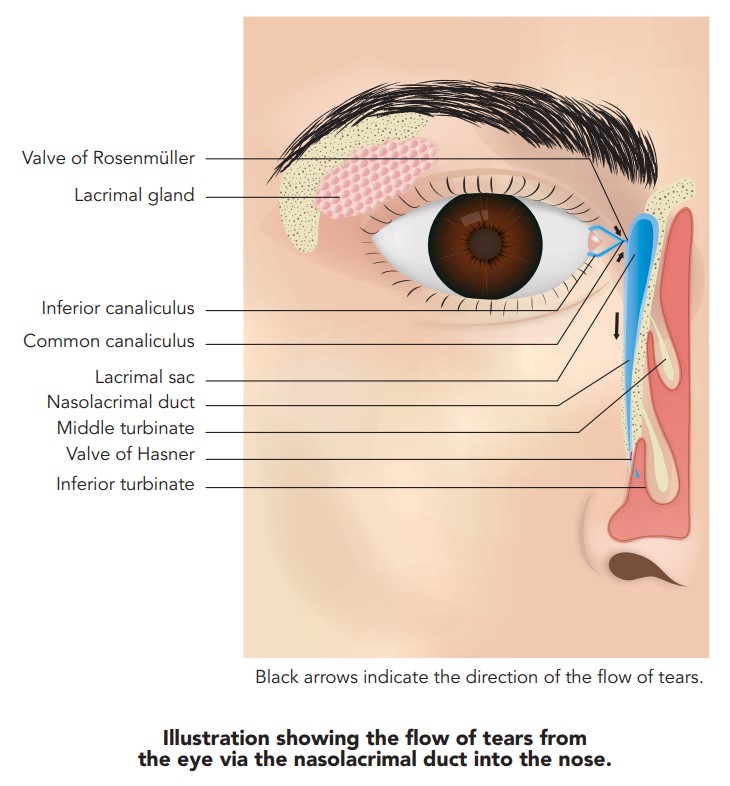
2. Congenital - in-born developmental abnormality of the valve of Hasner (see diagram above).
The primary acquired form of NLDO is the most common form of tear duct obstruction.
How will I know if I may have tear duct obstruction?
- The eye is constantly watery throughout the day.
- There may be a coloured or sticky eye discharge, sometimes with a foul smell.
- The eye is frequently watery or red on one side only.
Detection & Treatment
What is the treatment?
- Your doctor will diagnose the condition by performing a syringing examination of the tear drainage system.
- Surgery in the form of dacryocystorhinostomy (DCR).
What are the surgical options?
DCR is aimed at creating a small opening in the bone that surrounds the nasolacrimal duct (an osteotomy) to allow tears to drain and bypass the area of obstruction. A silicone tube is also inserted to maintain the ostium opening for a period of 6 - 12 weeks, depending on your condition.
There are 2 main approaches to DCR.
- 1. External dacryocystorhinostomy
A small skin incision is usually made on the area between the nose bridge and eyelid.
- 2. Endoscopic dacryocystorhinostomy
Surgery is performed through the nostril to avoid a skin incision.
Your surgeon may perform a nasal endoscopy procedure to determine suitability for this surgical approach.
Aspirin and anticoagulants
- These medications can cause significantly more bleeding during and after the surgery.
- If you take aspirin, or blood-thinning agents such as warfarin, you will need to check with your physician if you could safely stop these drugs.
- Some herbs or health supplements may also thin your blood to make surgery unsafe, please get advice from your doctor if you need to stop them before surgery.
What to expect on the day of the surgery?
- Same-day admission - overnight stay for one night to observe for any nose bleeding.
- A local anaesthetic injection is given to the eyelid area where surgery will be performed.
- The surgery is performed under general anaesthesia.
Care Management
What to expect post-surgery
- Usually only mild discomfort after surgery.
- Expect some swelling, bruising and tightness of the eyelids these will resolve once the wounds heal.
- Infrequently, slight asymmetry in the eyelid appearance or position might occur and may require additional corrective surgery.
Specialties & Services

