Overview
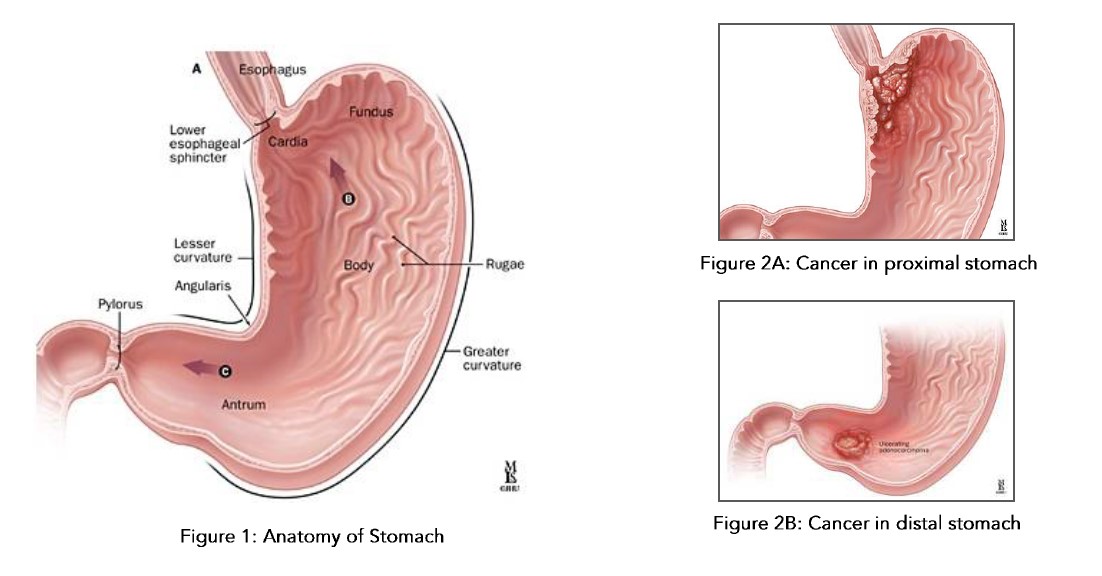
The stomach is an important part of the upper digestive tract.
Stomach cancer, also known as gastric cancer, is the cancer arising from abnormal growth of cells in the stomach lining.
Stomach Cancer in Singapore
In Singapore, stomach cancer is the seventh most common cancer in men and the ninth most common cancer in women. Stomach cancer also ranked fourth for cancer deaths of men and fifth for cancer deaths of women.
Causes
Risk Factors
- Helicobacter pylori infection (a type of bacteria that can live in the digestive tract)
- Nitrates and nitrites (nitrogen-based chemicals that are added to certain foods, such as ham and bacon)
- Red meats and salted, pickled or smoked foods
- Tobacco and alcohol use
- Gender (males have double the rate of stomach cancer compared to women)
- Stomach polyps (masses of cells formed on stomach lining)
- Previous stomach surgery
- Family history
- Obesity
- Pernicious anaemia (decrease in red blood cells when intestines cannot properly absorb vitamin B12)
- Weight loss
- Upper abdominal pain
- Sense of fullness / discomfort after a small meal
- Loss of appetite
- Heart burn or indigestion
- Difficulty swallowing
- Nausea
- Vomiting
- Black stool
- Anaemia (low number of red blood cells)
These symptoms may or may not be caused by stomach cancer. However, if you have these symptoms, do see your doctor to rule out stomach cancer.
Detection & Treatment
How Is It Diagnosed?
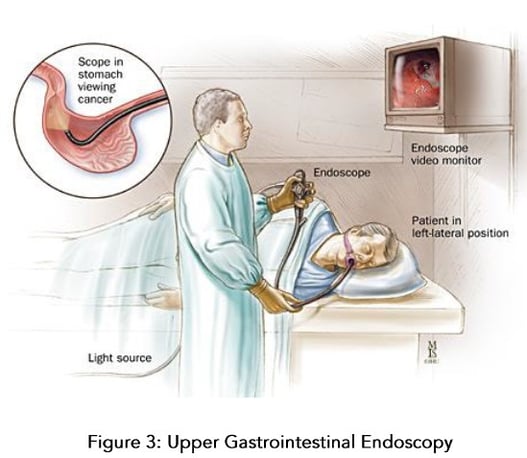
- Upper Gastrointestinal Endoscopy: Examination of the upper gastrointestinal tract (including oesophagus, stomach and part of small intestine) using a long, thin flexible tube with camera and light. This is to view the stomach lining and remove some cells or tissues to detect cancer.
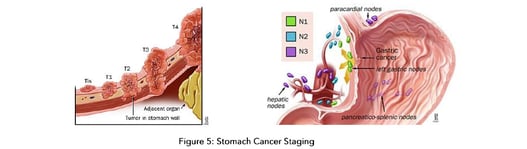
- Computed Tomography: A special X-ray imaging technology to detect the spread of the cancer in the body (cancer staging).
- Endoscopic Ultrasound: An ultrasound probe attached to an endoscope (a thin flexible tube with camera at the tip) to detect how deep the cancer has invaded. It is to also detect enlargement of nearby lymph nodes (small bean-like structures that form part of the immune system).
- Diagnostic Laparoscopy: A surgical procedure where a laparoscope (a thin tube with cameras and light) is inserted through a small cut near the belly button. This is to detect any spread of the cancer in the abdominal cavity.
- Endoscopic Mucosal Resection / Endoscopic Submucosal Dissection: These are endoscopic procedures (with use of an endoscope) meant for very early and small stomach cancer, limited to the innermost lining of the stomach. Depending on the size of the tumour, the surgeon may perform a dissection (cutting apart tissue), which may or may not require minor resection (removal of tissue or part of an organ).
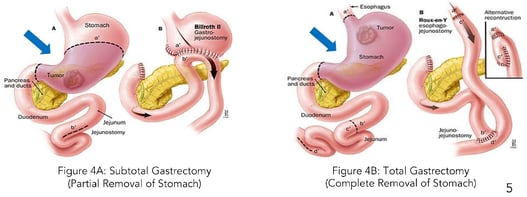
- Gastrectomy: Gastrectomy is a surgical procedure where all or part of the stomach is removed. It is the fundamental part of treatment to achieve cure in early stomach cancer. Nearby lymph nodes are also removed as part of tumour clearance. The remaining parts of the stomach or oesophagus will then be joined back to the small intestine to reconstruct the rest of the digestive tract. Surgery can be done laparoscopically (keyhole approach) in cases of early stomach cancer. Traditional open approach (non-keyhole) can be chosen in the case of advanced stage stomach cancer.
What are the Treatment Options?
Chemotherapy
- Chemotherapy refers to the use of drugs (chemotherapeutic agents) through veins or by mouth to kill the cancer cells in the body.
- Chemotherapy can be given before or after surgery, and with or without radiation therapy. It is also used for individuals who are not suitable for surgery.
Radiation Therapy
- Radiation therapy or radiotherapy is the use of ionisation radiation to kill or control the growth of cancer cells.
- This is usually given together with chemotherapy after surgery to kill the remnants of the cancer which could not be seen and removed during the surgery. It can also be used to control the symptoms in individuals with advanced stage stomach cancer.
Sources
(1) Singapore Cancer Registry, Interim Annual Report, Trends in Cancer Incidence in Singapore 2010-2014, by the National Registry of Disease Office (NRDO)
(2) "Stomach Cancer", article by Health Promotion Board, Singapore, URL (http://hpb.gov.sg/HOPPortal/dandc-article/588)
Illustration Copyright© 1998-2003 by The Johns Hopkins Health System Corporation and The Johns Hopkins University; used with permission from the Johns Hopkins Division of Gastroenterology and Hepatology (www.hopkinsmedicine.org/gi). Illustration created by Mike Linkinhoker.
Specialties & Services

