Overview
What is a Refractive Error?
A refractive error occurs when light rays entering the eye are not precisely focused on the retina (internal light-absorbing surface) of the eye. The cornea and the lens help to focus light onto the retina in the eye.
Types of Refractive Errors
- Myopia/Short-sightedness
- Hyperopia/Far-sightedness
- Astigmatism
Causes
What is Myopia/Short-sightedness?
Myopia occurs when light entering the eye is focused in front of the retina. This happens when the eyeball is too long or has excessive focusing power.
Myopia can be hereditary and has been associated with excessive near work. Some studies have also suggested that more time spent outdoors resulted in less myopia progression.
What is Hyperopia/Far-sightedness?
Hyperopia occurs when light entering the eye is focused behind the retina. This happens when the eyeball is too short, or has insufficient focusing power.
Some amount of hyperopia is normal in childhood. Spectacles are not usually required, as children can use their natural focusing mechanism (accommodation) to sharpen their vision. Larger amounts of hyperopia can be associated with crossed eyes (accommodative esotropia), poor vision or amblyopia (lazy eye), and will require correction with full-time wear of spectacles. Hyperopia decreases during the pre-teen to early teenage years.
What is Astigmatism?
Astigmatism occurs when the shape of the cornea (front surface of the eye) is irregular and not equally round in all directions. Instead of being regularly round in all directions (like a ping-pong ball), a cornea with astigmatism is shaped more like an egg, which is more rounded in one direction and less rounded in another direction.
Light entering an eye with astigmatism is not clearly focused onto the retina, thus resulting in blurred and distorted vision.
The tendency to develop astigmatism is usually inherited and a small amount of astigmatism is common. A large amount of astigmatism can be associated with thinning disorders of the cornea, such as keratoconus, that change the shape of the cornea.
Injury to the cornea and corneal scars can also result in astigmatism. Very rarely, excessive and vigorous eye rubbing can induce astigmatism by altering the shape of the cornea.
Significant astigmatism that is not corrected with spectacles can interfere with normal vision development in children, causing poor vision and lazy eye (amblyopia)
High Myopia:
Patients with higher degrees of myopia are at a greater risk of complications in adulthood that can cause blindness, such as glaucoma, cataract, retina detachment and macula degeneration.
Laser and surgical vision correction for high myopia can help to achieve freedom from having to wear glasses and contact lenses, but does NOT prevent or lower the risk of complications (of high myopia) from occurring.
Detection & Treatment
Atropine for Rapid Myopia Progression:
Patients who demonstrate rapid progression of myopia in excess of 100 degrees a year may benefit from the use of atropine eye drops to slow down myopia progression.
Low-dose (0.01%) atropine eye drops have been found to be effective in slowing myopia progression by about 50-60% over a 2-year period, with minimal side effects. Special tinted or progressive-add glasses are not required. Higher-dose atropine (0.5% and 1%) may be considered in patients who do not respond well to low-dose atropine.
Treatment of Refractive Errors:
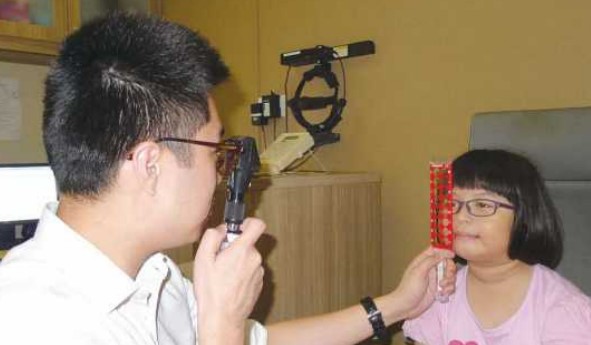
Significant refractive errors are usually treated with glasses and spectacles.

At the appropriate age and maturity, responsible patients can also wear contact lenses to correct their refractive errors.
When refractive errors have stabilised, laser and surgical vision correction can also be considered after the age of 21 to achieve spectacle independence (freedom from wearing spectacles).
Specialties & Services

