Overview
What is Pterygium?
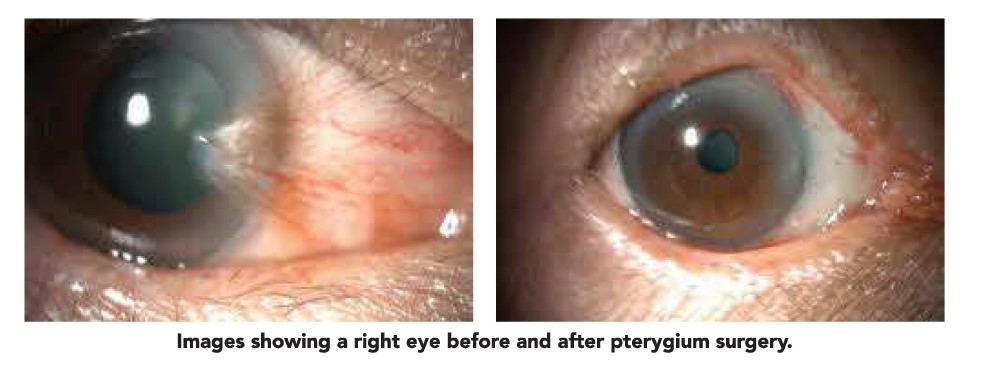
A pterygium is a wing-shaped, benign growth of conjunctiva! tissue across the cornea. It usually occurs on the side of the eye and grows very slowly over many years. Risk factors which have been associated with pterygium include ultra-violet radiation from sunlight exposure and chronic eye irritation from dry climate.
How does Pterygium affect the eye?
In the early stages, there may be irritation and eye redness but vision is normally not affected. As the pterygium grows larger, it may blur the vision by causing astigmatism or blocking the visual axis.
Why do I need Pterygium surgery?
You have been advised to undergo pterygium surgery. The indications for pterygium surgery are:
- When vision is affected
- Persistent, significant irritation
- Eye movements are restricted by the pterygium
- Cosmesis
- Others
Detection & Treatment
What are the options?
Currently, there is no non-surgical treatment that will cause a pterygium to disappear once it has formed. If the pterygium is small, it may be observed for growth and artificial tear eye drops may be used to relieve irritation or redness.
What will happen if I do not undergo the procedure?
Your eye doctor has already informed you that it is advisable to undergo surgery at this stage. If the pterygium is not removed, it may continue to grow and extend further over your cornea causing visual blurring and affecting vision. Later surgery may result in a larger corneal scar that may cause a poorer visual result after surgery.
How is Pterygium surgery performed?
The pterygium is removed from the cornea and sclera. To prevent recurrence, a free flap of adjacent conjunctiva (conjunctiva! graft) or amniotic membrane graft is transferred over the bare sclera and secured with absorbable sutures or tissue glue. Occasionally, anti-scarring agents may be used. The surgery usually takes about 30 - 40 minutes. When the operation is over, the nurses will place a pad and plastic shield over your eye for protection.
What are the risks and complications of the surgery?
Pterygium surgery only involves the outer layers of the eye, therefore it is relatively safe and with a very low risk of any complications compared to other types of eye surgery. It is crucial that you know the potential risks and outcomes of pterygium surgery before proceeding. The most important complications are mentioned and the following list is not exhaustive:
Recurrence of pterygium
There is a 10% risk of recurrence of pterygium despite successful removal. Depending on the size of regrowth, repeat surgery may or may not be necessary. Surgery for a pterygium that has regrown has a much higher risk of recurrence.
Loss of vision
This is an exceedingly unlikely complication, but may result from damage to the eye during anaesthetic injection or from a severe infection.
Squint
Very uncommonly, an eye muscle may be damaged during removal of pterygium leading to a squint. This may require another operation to correct the misalignment of the eye.
Bloodshot eye
The eye is usually very red and swollen immediately after surgery. However, this is temporary and usually subsides after several weeks.
Loosening of the graft
Occasionally, the conjunctiva! graft may come loose. Though rare, this may require re-stitching of the graft.
Corneal scar
There may be a residual scar on the cornea despite a successful surgery. This may cause blurring of vision which is usually of a lesser degree than before surgery.
Risks related to anaesthesia
Post-operative nausea and vomiting
You may experience this after surgery, especially if you have a previous history of nausea and vomiting after anaesthesia. In general, this is reduced with the use of anti-vomiting medications given during surgery.
Strokes and heart attacks
There are low risks of strokes or heart attacks occurring at times of stress and anxiety, such as during surgeries. These risks are increased if you have uncontrolled medical conditions. The pre-operative tests will assess your suitability for surgery, and reduce the risk of such complications.
WHAT DO I NEED TO DO BEFORE THE SURGERY?
Tests before surgery
Pre-operative tests: Depending on your age and health, pre-operative tests such as a blood pressure check, blood test, electrocardiogram (ECG) and chest x-ray (CXR) may be necessary to determine if you are fit for surgery.
WHAT CAN I EXPECT ON THE DAY OF SURGERY?
Before surgery: Do remember to follow specific fasting instructions given to you. The surgery is performed under regional anaesthesia in the operating theatre as a day case. The anaesthetic mixture is injected around the eye to make the whole eye numb for several hours. Additional medications may be given to relax you. Monitor leads will be attached to your chest, arm and fingertip. The skin around your eye will be cleaned and you will be covered with a sterile sheet of cloth . Oxygen is constantly being blown under the sheet and a member of staff is always close by in case you experience any discomfort during the operation.
Surgery: Most pterygium operations take about 30 - 40 minutes but the operating time can vary, depending on the complexity of the procedure and whether there has been previous eye surgery.
After surgery: You will be transferred to the recovery area. After a period of observation and detailed discharge advice from the nurses on eye care, you will be ready to go home.
You will be given eye drops or eye ointment to use in the operated eye(s) after surgery. Specific instructions on how to care for your eyes after surgery will be provided. Follow up appointment will be arranged before you leave the Day Surgery Unit.
You will need to have someone to accompany you home after the surgery and do not drive yourself on that day.
Care Management
PTERYGIUM SURGERY POST-OPERATIVE INSTRUCTIONS
This section provides key information for after-care in patients who have undergone pterygium surgery. Taking these precautions may help to reduce risks and complications.
The time frames stated are rough guides, and may differ from patient to patient. Always clarify any doubts with your doctor.
Immediately After Surgery
There may be some eye discomfort, eye redness and mild eyelid swelling. The ward nurse will clean the eye and instill eye drops or eye ointment for you. She will show you and your care-givers how to instill the eye medications and advise you on eye care.
When can I go home?
You will usually be able to return home on the day of surgery, once you are fully alert and your post-operative condition is stable.
THE FIRST FEW DAYS AFTER SURGERY
What to expect
- Blood-stained tears initially, which should quickly subside.
- Some eye discomfort and mild pain, settling over 1 - 2 weeks. Oral pain-killers can be taken as needed.
- Some eye redness and eyelid swelling is expected, subsiding over 1 - 2 weeks.
- Vision may be blurred initially. This will steadily improve over 1 - 2 weeks.
- Clinic visits: One visit the very next day, then once or twice in the next few weeks.
What I must do/what is safe to do
- Start all medications as prescribed.
- Apply the eye drops/ ointment as instructed. Refer to the section on "Eye drop /ointment medications".
- Clean your eyes as instructed twice daily with moistened sterile/clean cotton balls. Cotton balls can be moistened with sterile saline or cool boiled water.
- Rest at home for the first 3 days.
- The following activities are safe: reading, computer work and watching television as tolerated.
- There is no dietary restriction. Take plenty of fruits and vegetables to avoid constipation.
ABOUT 2 WEEKS AFTER SURGERY
What to expect
- Eye discomfort should be less.
- Blurred vision getting better; vision more stable.
- Your eye specialist will gradually tail down your eye drops over the next few weeks.
What I must do/what is safe to do
- You can resume most other activities once you feel up to it.
- As above.
ABOUT 4-6 WEEKS AFTER SURGERY
What to expect
- Your eye should feel more comfortable.
- There may be removal of sutures (stitches) in some cases.
- New glasses may be prescribed 6 - 8 weeks after surgery if necessary.
- Your eye specialist will gradually tail off your eye drops.
What I must do/what is safe to do
- Light exercise like walking is allowed.
WHAT TO AVOID
- Avoid crowded and dusty places (first 1 week).
- Coughing or sneezing too hard (2 weeks).
- Work (usually 2 - 4 weeks hospitalisation leave is given).
- Strenuous physical activities, e.g. jogging, badminton (for 4 weeks).
- Carrying children who may accidentally poke your eye (4 weeks).
- Lifting heavy objects or bending over at the waist (4 weeks); if necessary, when picking up something from the floor, do it with a straight back and take care not to knock the head while standing up.
- Rubbing/placing pressure on the eye or closing it too tightly (4 weeks).
- Water/soap entering the eyes (4 weeks). If this occurs, wash it out by instilling the eye drops prescribed.
- Swimming and hot tubs (4 weeks).
- Driving or riding a bike (subject to your doctor's advice).
MEDICATIONS
- Eye drops and all medications to be taken as prescribed.
- Most other oral medications can be continued upon returning home.
- However, please note that aspirin, anti-coagulants and other anti-platelets can be continued only after consulting your surgeon.
Eye Drop Treatment
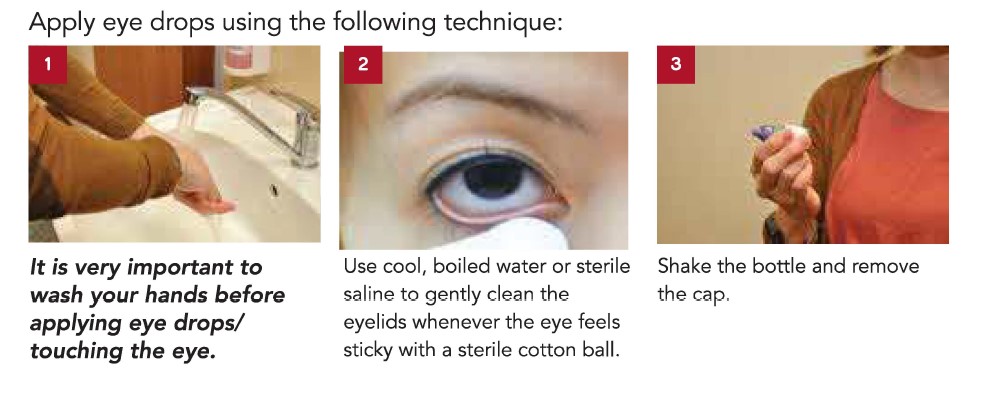
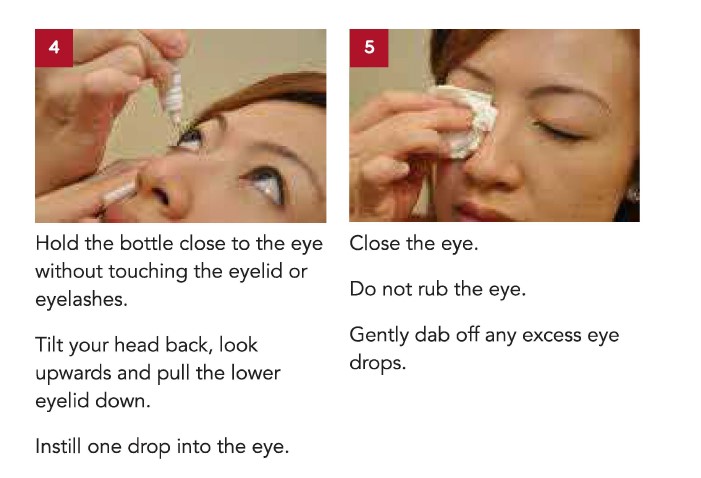
Apply eye drops using the following technique:
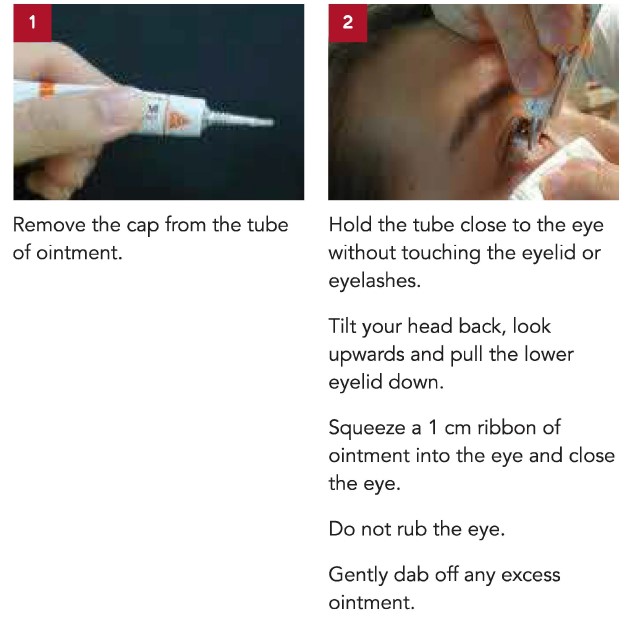
EYE OINTMENT APPLICATION
IN ALL CASES
- Keep eye drops in a cool place.
- Discard the eye drops one month after opening or upon their expiry date.
- If more than one type of eye drops are to be applied to the same eye, wait 3 - 5 minutes before instilling the next eye drop.
- Always instill eye drops before eye ointment.
Specialties & Services

