Overview
What is AION?
AION is anterior ischaemic optic neuropathy.
There are 2 types of AION:
- Arteritic (AAION)
- Non-arteritic (NAION)
NAION is the most common cause of unilateral vision loss in patients older than 50 years of age. AAION is uncommon in our Asian population.
Causes
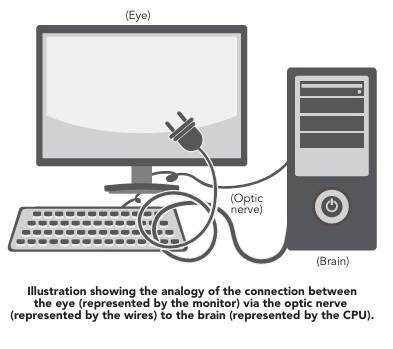
Our vision is like a computer (Fig. 1). The eye is like the monitor screen, the information passes from the screen to the CPU via the wires. Our optic nerves are like the computer wires which connect our eye to the brain to process what we see.
There is only one optic nerve for each eye and it gets its blood supply from arteries in the eye socket, namely the posterior ciliary arteries.
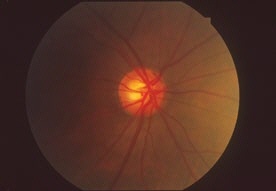
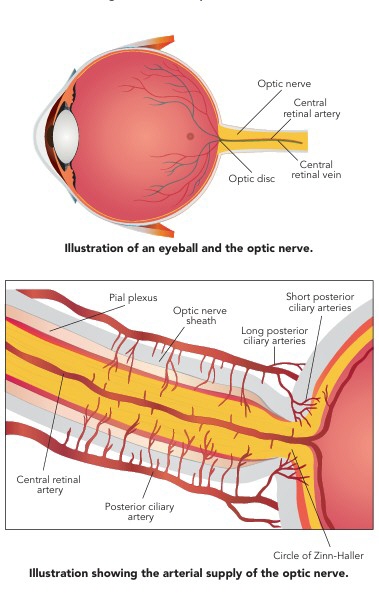
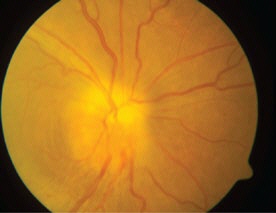
In AION, there is loss of blood supply to the posterior ciliary arteries which results in a small 'stroke' of the optic nerve. However, unlike other 'strokes', the patient does not get weakness, numbness or loss of speech, nor is there an increased risk of a classic stroke later. This loss of blood supply or "ischaemia" to the optic nerve results in swelling of the nerve (also called the optic disc) (Fig. 2) causing it to swell. The swelling will resolve after some weeks but the nerve turns pale as some of it is damaged irreversibly.
We do not completely understand the cause of the loss of blood supply to the optic nerve. We do know that this happens more often in patients who have some of the following:
- Patients who are born with small optic discs.
- A sudden drop in blood pressure, especially at night.
- Sleep apnoea.
- Smoking.
- Diabetes.
- High blood pressure.
- Some drugs such as Viagra.
Classically, patients with NAION will experience the vision loss upon waking. The visual loss typically:
- Involves half of the patient's vision (usually the lower half).
- Is sudden and painless.
- Usually affects only one eye at a time.
A small group of patients may have AAION, which is an inflammation involving the arteries. This is rare, and usually in very elderly patients. Their symptoms include:
- Loss of vision.
- Headache and scalp tenderness.
- Pain when chewing.
- Previous episodes of visual loss and recovery.
- Weight loss.
- Fever.
- Pain in their shoulders and hips.
Detection & Treatment
Unfortunately there is no proven treatment for the condition at present.
Care Management
Some measures to prevent a similar episode in your other (fellow) eye are:
- Keep your blood pressure and cholesterol in the normal range.
- Stop smoking.
- Control your blood sugar level if you have diabetes.
- Avoid having too low a blood pressure, especially at night – you should speak to the doctor who is looking after your blood pressure to adjust the timing of your medications as necessary.
- Manage your sleep apnoea.
What is the outlook for this condition?
Forty percent of patients may expect some improvement in vision, however, 30% may also deteriorate and 30% will remain stable.
Fortunately, this condition rarely occurs a second time in the involved eye. There is a 10 – 20% chance of affecting the fellow eye, but the majority of patients remain stable
Specialties & Services

