Narrow Angles (Primary Angle Closure Suspects)
Overview
What does the condition Narrow Angles mean?
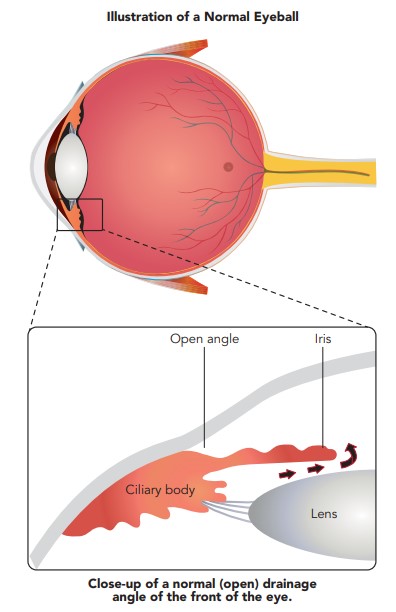
- The angle of the eye is the area where fluid normally drains out of the eye.
- In some individuals, the angle is narrower than normal, and this often gets worse with advancing age due to the development of cataracts.
- If the angle is narrow but not totally closed, the intraocular (eye) pressure would most likely be normal without any evidence of glaucoma, that is without any damage to the optic nerve. Individuals who have this are called primary angle closure suspects.
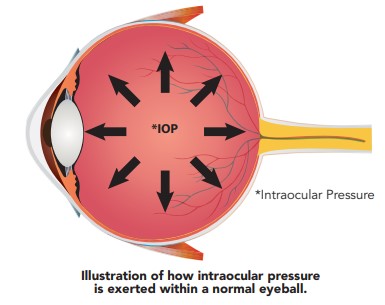
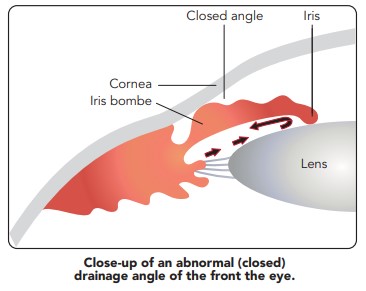
- However, if the angle is already narrow, it could actually physically close suddenly in certain circumstances thereby blocking the drainage system of the eye and resulting in a sudden increase in the intraocular (eye) pressure. This would cause sudden pain and redness of the eye with blurring of vision. This condition is called acute angle closure glaucoma and can be potentially serious and difficult to treat.
- In some individuals with narrow angles, there could also possibly be intermittent episodes of raised intraocular pressure which could result in intermittent episodes of mild eye pain or headaches. In some individuals, sustained increase in the intraocular (eye) pressure may develop and damage the optic nerve. This condition is called chronic angle closure glaucoma (CACG).
Causes
Risk factors for Narrow Angles (PACS):
- Family history of narrow angles
- Family history of angle closure glaucoma
- Age ≥40 years old
- Severe long-sightedness (hyperopia)
- Certain ethnic groups are more likely to have narrow angles, in particular East Asians.
Detection & Treatment
How do I know if I may have Narrow Angles (PACS)?
- This can only be diagnosed by an eye specialist.
- The eye specialist will use a special lens to visualize the angle of your eyes to confirm whether you have narrow angles. The lens will be lightly touching the eye after a topical anaesthetic eye drop is applied to numb your eye. This procedure (gonioscopy) is very safe and does not cause any pain.
- Occasionally, the eye specialist may also order a special imaging test using a machine (anterior segment optical coherence tomography) to better visualise your angles.
Is there any treatment for PACS?
Treatment is usually advised once narrow angles are diagnosed because of the risk of developing acute angle closure glaucoma.
There are 2 treatment options available:
- Prophylactic laser peripheral iridotomy (laser PI)
- Cataract surgery - if you already have a cataract
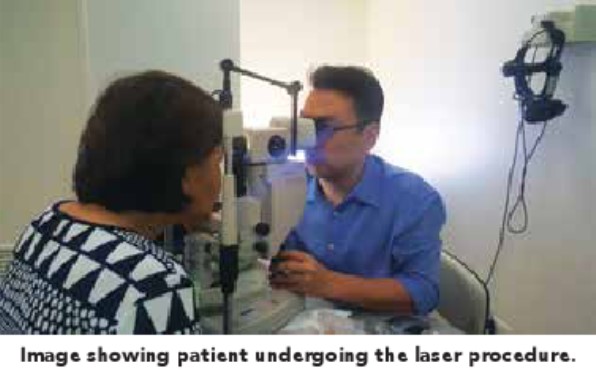
Laser Iridotomy:
- This is a day laser procedure performed in the eye clinic itself.
- A small opening is made in the top peripheral part of the iris in the eye.
- It aims to open up and deepen the narrow angle.
- This laser does not improve vision. It is meant to prevent acute angle closure attack (acute glaucoma attack).
Cataract surgery:
This option is suitable for the narrow angle patient who already has a cataract as removal of the cataract very often results in a natural deepening of the angle.
Additional Resources
Specialties & Services

