Overview
Laryngeal Cancer
Larynx (or voice box) cancer is much more common in men than in women in Singapore. However, the overall incidence is decreasing.
Causes
Main Causes
- Smoking
- Excessive alcohol consumption
- Hoarse voice
- Blood in phlegm
- Difficulty in breathing
- Noisy breathing (stridor)
- Lymph glands in the neck
- Weight loss
Detection & Treatment
Examination and Tests
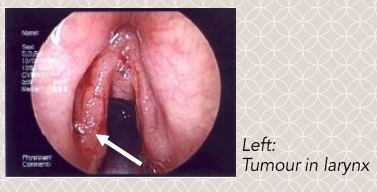
Your doctor will perform a nasoendoscopy procedure, where a fibreoptic camera is passed through your nose to obtain a view of the voice box.
Two types of investigations are required:
- Biopsy of the voice box to determine the presence of cancer. This is done under general anaesthesia.
- Scans to determine the spread of the disease. Commonly-performed scans include:
- Magnetic Resonance Imaging (MRI) scan of the larynx and neck
- Positron Emission Tomography (PET) scan of the whole body

Treatment
The treatment of larynx cancer depends on the stage of disease:
- Early stage: Either surgery OR radiotherapy
- Advanced stage: Surgery and radiotherapy OR chemoradiotherapy
Chemoradiotherapy has the advantage of retaining the larynx but only some patients are suitable for this treatment. Your doctor will explain which treatment is most suitable for you.
You will also need to undergo speech rehabilitation as surgical removal of the larynx will affect your speech.
Care Management

Specialties & Services

