Overview
What is a Cataract?
A cataract is the clouding of the lens of the eye. The lens is naturally transparent and focuses incoming light rays to form a sharp, distinct image on the retina. This is similar to the way a camera lens focuses images onto film. A cataract is like a cloudy camera lens. It blocks light rays from entering the eye, resulting in blurred vision.
Causes
What causes a Cataract?
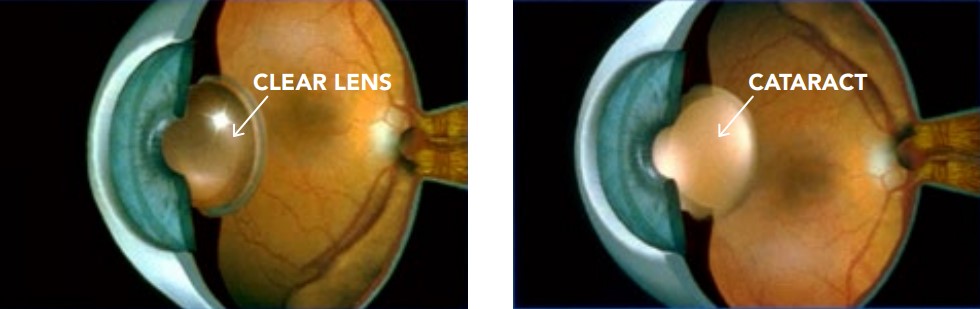
A cataract can be categorized according to its underlying cause.
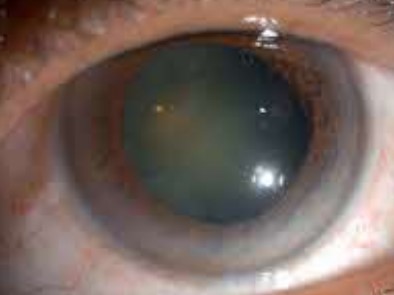
- The most common cause is due to ageing. This is called Senile Cataracts. The normal ageing process hardens and opacifies the lens. This commonly affects adults above the age of 50.
- Patients with poor diabetic control are also prone to cataracts. Diabetic Cataracts can cause fluctuating vision due to poor control of sugar levels.
- Eye injuries may also damage the lens resulting in Traumatic Cataracts.
- Congenital Cataracts are present at birth. These are usually hereditary or caused by an infection that had affected the pregnant mother and the unborn child.
- Secondary Cataracts are cataracts caused by medication or other diseases of the eye or body (eg. steroids, inflammatory disease, metabolic disease).
What are the symptoms cataracts?
The main symptom is blurred vision. Other symptoms include:
- glare
- poor vision under poor lighting
- seeing multiple images, and
- the need for frequent spectacle prescription changes
Detection & Treatment
What treatment is available?
Treatment for a cataract is warranted when it affects a person's lifestyle. Surgery is the only effective way to remove a cataract. Fortunately, cataract surgery is usually highly successful with more than 90% of patients attaining good vision.
This high success rate is attributed to advances in surgical microscopes, machines and equipment, effective prevention of infections and early mobilization. Almost all cataract surgeries are performed as day surgical procedures without the need for hospital admission.
Cataracts cannot be removed with medication. The decision for removal of the cataract should be made only after consultation with an eye specialist
Phacoemulsification
This is the most common cataract surgery technique in developed countries. Using ultrasonic power, the cataract is broken down and removed through a small wound. Suturing is usually not required and vision restoration is fast.
With cataract removal, an artificial lens implant is needed to replace the original lens to focus light rays onto the retina. This can be achieved in the following ways:
Foldable Intraocular Lens Implants
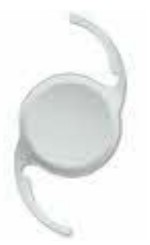
This is the most frequently used implant. As the lens is foldable, it can be placed into the eye through a small wound usually without the need for sutures. The implant then unfolds itself into its appropriate position in the eye. The small wound heals quickly and visual quality is excellent.
Hard Intraocular Lens Implants
These are non-foldable artificial lenses placed in the eye for cataract surgeries requiring large wounds, called extracapsular cataract extraction. These are usually done for patients with very advanced and dense cataracts
In the days before intraocular implants, patients were required to wear aphakic glasses. However, these spectacles were thick and heavy, providing poor quality of vision.
Today, with the advent of intraocular lens implants, spectacles are used only to correct any mild residual power, if any. As these prescriptions are generally very mild, the spectacles are much thinner and lighter, with no adverse impact on quality of vision
Tests before surgery
A technician will need to perform some biometric tests of your eye to enable the surgeon to select an appropriate intraocular lens implant.
You may also be required to undergo a blood test, blood pressure check and electrocardiogram (ECG) to ensure that you are fit for surgery.
You will then be given fasting instructions and eye drops to use before the surgery.
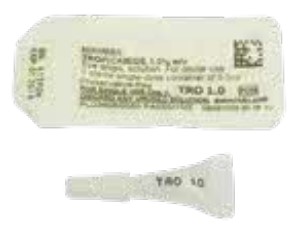
Dilating eye drops
- On the day of surgery, instill one drop just before leaving your home for the hospital
What happens when I arrive for surgery?
You will first be given eye drops to enlarge your pupil. A dilated pupil is essential to allow your surgeon to access the cataract and perform your surgery safely.
What happens during Cataract surgery?
Before the start of surgery, you will be given an anaesthetic, either as an injection or in the form of eye drops, to make the surgery painless. Additional medications may be given through your bloodstream to help you relax and prevent discomfort. Monitors will be attached to your chest, arm and fingertip. The skin around your eye will be cleaned and you will be covered with a sterile surgical drape.
During the surgery, the cataract is removed from the eye and replaced with an artificial intraocular lens. There are two surgical techniques. One method is called phacoemulsification as mentioned above, which uses ultrasonic energy to break up the cataract through a small wound. There is usually no requirement for sutures. The other method is called extracapsular cataract extraction, which requires a larger incision and several sutures. The surgeon will decide on the best technique suited for you. Both methods have equally good long-term outcomes.
During the procedure, it is normal for patients to see bright lights, colours, shapes and movement. Do not let these alarm you.
What happens immediately aſter Cataract surgery?
At the end of surgery, the nurses will place a shield over your eye to protect it.
After which you will be transferred to the recovery area, and following a period of observation and detailed advice from the nurses on eye care, you will be ready to go home.
Please arrange to have someone to accompany you home. Do not drive on the day of surgery.
What are the complications of Cataract surgery?
Cataract surgery is one of the most successful operations with about 98% completed without any complications. However, it is still crucial that you know the potential risks of cataract surgery before proceeding.
The following list is not exhaustive but includes the most important complications, all of which are uncommon:
- Damage to the lens membrane (rupture of lens capsule)
- Severe infection
- Severe internal eye bleeding
- Retinal tear or detachment
- Raised pressure of the eye
- Corneal swelling
- Retinal swelling
- Droopy eyelid
- Unexpected refractive outcome needing a lens implant exchange
- Inflammation of the opposite eye
- Loss of vision
- Risks of anaesthesia
- Risks to general health
Seek early consultation with your doctor or the Emergency Department if you have any of these symptoms.
MEDICATIONS
- Eye drops and all medications to be taken as prescribed (refer to annex "Eye Drop Medications").
- Most other oral medications can be continued upon returning home.
- However, please note that aspirin, anticoagulants and other antiplatelets can be continued only after consulting your surgeon.
Eye Drop Medications</p
Care Management
What can I expect in the days following Cataract surgery?
Sensations: After cataract surgery, it is normal to feel mild irritation in the eye. You may also have some tearing and be sensitive to light for a period of time. Sunglasses may be worn for this.
Medications: You will need to diligently apply eye drops and any other medications that your doctor may prescribe to aid healing and prevent infection for a few weeks following surgery. The medication will be gradually reduced over one month or so.
Precautions: The eye should not be rubbed during the first few weeks after surgery. You may be asked to wear a shield over the operated eye, particularly while sleeping for 1 to 2 weeks. For the first few weeks, be careful not to get any water, face cream, soap or shampoo into the operated eye. You may wash your hair by tilting your head backwards for the first 2 weeks after surgery or go to a hair salon for assistance.
Follow-up Visits: After uneventful surgery, your doctors will need to review you about 3 times over the next month: usually 1 day after the operation, 1 week following that and then 3-5 weeks later.
Activities: You may resume most normal activities on the day following surgery. Activities such as reading, watching television, cooking, and light exercises will not harm the operated eye. Do not engage in strenuous activities eg. jogging, swimming, ball games. Try to avoid bending at the waist or heavy-lifting for a few weeks after surgery.
Diet: There are no special dietary restrictions following cataract surgery.
Glasses: Most surgeons recommend waiting about 4-6 weeks before prescribing glasses.
How soon will my vision improve aſter Cataract surgery?
Vision will usually improve within a few days, although the best vision may not be obtained until after several weeks. The results vary between individuals. The benefits of surgery include improved clarity of vision, improved contrast and colour vision, improved independence, quality of life and reduced dependence on spectacles
Specialties & Services

