Overview
What is Ankylosing Spondylitis (AS)?
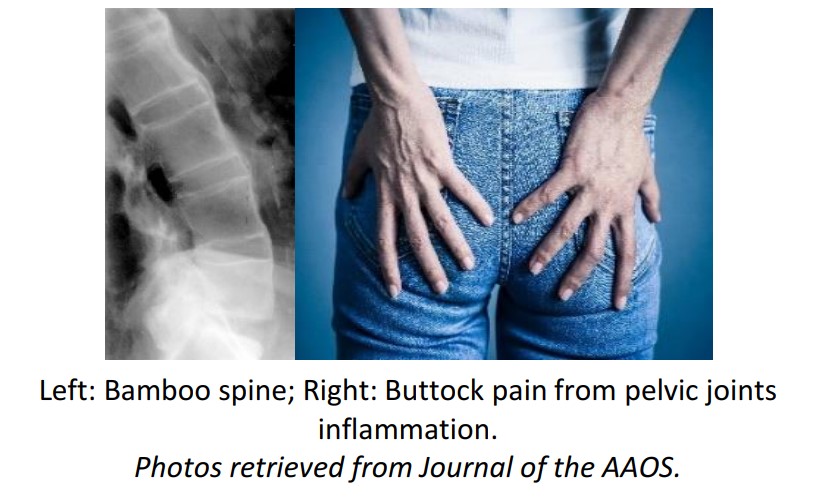
Ankylosing Spondylitis (AS) is a chronic inflammatory disease that affects the sacroiliac joints (in the pelvis) and spine, causing severe pain and stiffness in the back. As the condition progresses, the entire spine may fuse together, causing deformity and inflexibility. This fusion resembles a "bamboo spine".
Causes
What Causes AS?
Although the cause of AS is currently unknown, people with HLA-B27 gene are at higher risk of developing this disease.
Who are at Risk of AS?
AS mainly affects young people from the age of 15 to 35. Men are two to three times more prone to developing this condition than women. A child has 10% chance of developing AS if an immediate family member (i.e. parents, siblings) has this condition.
Symptoms and Signs of AS
In the early stages of AS, most people experience unusual short-term pain and stiffness in the lower back that is worse in the morning on getting up from bed. Unlike back strains, these symptoms improve with exercise rather than with rest.
In the later stages, patients experience full back pain and stiffness that affects the entire spine and lasts the whole day. Shoulders, hips, knees and other joints may also be affected.
Other symptoms include:
- Fatigue, poor appetite and weight loss
- Progressive difficulties in carrying out daily activities (e.g. walking, getting out of bed, bending forward)
- Affect tendons and ligaments (e.g. Achilles tendonitis)
- Eye inflammation (uveitis)
- Affect heart, lungs or kidneys (rare, but possible)

Detection & Treatment
How is AS Diagnosed?
AS is diagnosed by taking a detailed history and physical examination of patients.
X-rays of the sacroiliac joint and spine may be used to detect the later stages of AS but less effective for early stages. MRI scans of the spine and sacroiliac joints may show evidence of early AS but is can be more costly.
Other laboratory tests commonly performed include:
- Basic blood tests, which include full blood count and renal panel
- Inflammatory markers
- Urine tests
- Genetic tests to detect if patients have the HLA-B27 gene
Depending on the symptoms, further assessments may be required for:
- Eye inflammation – referral to an ophthalmologist
- Bowel/intestinal inflammation – referral to a gastroenterologist, endoscopy (colonoscopy)
- Heart complications – referral to a cardiologist, heart and scans
How is AS Treated?
Although there is currently no cure for AS, effective treatments are available to relieve the pain and stiffness. Prevention or the delay of complications and deformity can be achieved through:
1. Patient Education
Empower yourself with knowledge and take charge of your health. One way to obtain more information about AS is through support groups such as the Singapore Ankylosing Spondylitis Club.
Scan the QR code below to join or access https://bit.ly/ASclub.
2. Physical Therapy and Lifestyle Changes
Maintain a healthy lifestyle by participating in specially-designed exercises to reduce stiffness of the spine and strengthen your back muscles. Swimming is also strongly encouraged.
Maintaining good posture and performing day-to-day functions like sitting, lifting of heavy objects safely at home and at work is encouraged. Stop smoking.
3. Medication
Non-Steroidal Anti-Inflammatory Drugs (NSAIDs)
These are used to reduce inflammation, pain and stiffness of the spine. These may be prescribed together with other pain relief drugs like paracetamol and tramadol.
Disease-Modifying Anti-Rheumatic Drugs (DMARDs)
Although these are ineffective for the spine, they are used to treat other affected joints.
Biologics
These are medical products that are extracted or produced from biological sources. They are expensive and are reserved for patients with AS that is not controlled despite conventional therapy.
Surgery
This may be recommended if you have severe joint damage (e.g. hip replacement at the hip joint).
Care Management
Can This Condition Be Cured?
With early diagnosis and effective treatment, patients may benefit from the relief of spinal and joint symptoms, with reduced spinal and joint deformities. By maintaining a healthy lifestyle and taking medications regularly, people with AS can lead a relatively normal and productive life.
Specialties & Services

