Overview
Understanding Adult Hydrocephalus
Cerebrospinal fluid (CSF) is produced by and flows through the brain and spinal cord. It protects and provides nutrients to the brain and spinal cord. CSF is absorbed into the bloodstream.
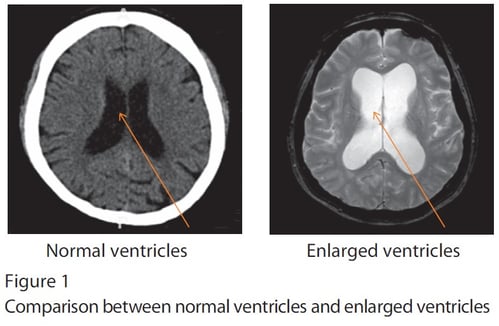
Hydrocephalus is a condition where there is excessive CSF in the brain. When the production and absorption of CSF are affected, the cavities (ventricles) of the brain enlarge, increasing brain pressure (Figure 1).
Understanding Normal Pressure Hydrocephalus
Normal Pressure Hydrocephalus (NPH) is seen in older adults and occurs when CSF builds up slowly in the brain cavities. Brain enlargement takes place over time and common signs and symptoms include:
- Difficulty walking, resulting in falls and head injuries
- Memory issues
- Inability to control bladder
Not all symptoms are present at the same time. Sometimes, only one or two show up.
Patients with NPH may respond to shunt treatment. Speak to your doctor for details on how to manage NPH
Causes
The cause of hydrocephalus is usually unknown but could develop due to:
- Injury or trauma to the head or brain
- Infection
- Bleeding
- Tumour
- Headache
- Blurred/double vision
- Nausea and/or vomiting
- Drowsiness
- Problems with thinking and memory
- Balancing and/or walking issues
- Inability to control bladder
Detection & Treatment
Diagnosing Hydrocephalus
An examination and a Computed Tomography (CT) or Magnetic Resonance Imaging (MRI) scan are needed to confirm the diagnosis.
Treating Hydrocephalus
Treatment depends mostly on the type of hydrocephalus and the patient's condition.
1. External Ventricular Drain (EVD)
A drain is temporarily inserted to remove excess CSF and reduce brain pressure.
2. Shunt
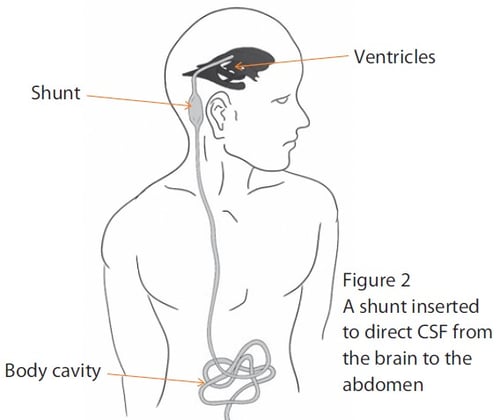
A permanent tube (shunt) may be inserted to direct CSF from the brain to other parts of the body like the abdomen for absorption (Figure 2).
Though uncommon, shunt complications include:
- Infection
- Bleeding
- Stroke
- Shunt malfunction
- Flow obstruction
- Over or under-draining of CSF
Generally, patients are on long-term monitoring but can go about their daily activities.
3. Endoscopic Third Ventriculostomy (ETV)
Procedure to open a path in the brain cavities for CSF to flow.
Content serves as a guide only. Seek the advice of your doctor for more details
Information correct as of September 2020
Reproduced with permission from the National Neuroscience Institute (NNI)
Specialties & Services

