NHG Health's Centre for Healthcare Innovation (CHI) Marks 10 Years with the Launch of the CHI Workforce Accelerator
At A Glance
CHI Workforce Accelerator hosted by NHG Health: Singapore’s first structured platform to advance healthcare workforce transformation. It will drive workforce transformation into implementation through job redesign, rapid prototyping and cross-sector collaboration.
Job Expo ’36 (JETS): Showcases 36 reimagined healthcare roles with a forward view of how work, skills and care models may evolve by 2036.
AI and Technology-Enabled Workforce: NHG Health’s consultation paper on agentic AI as a workforce strategy, the CHI Clinical AI Fellowship, and VirtCHILL as an XR-enabled training platform.
National Healthcare Innovation and Productivity (HIP) Medals: Recognise system-level innovations in care redesign, workforce transformation and technology adoption.
Singapore, 2 July 2026 – Healthcare systems face mounting pressures from ageing populations, evolving care needs and rapid technological change. These developments make workforce redesign more urgent than ever. The Centre for Healthcare Innovation (CHI) of NHG Health is advancing a vision for the future workforce through Job Expo ’36 (JETS) as part of its 10th anniversary celebrations during CHI INNOVATE 2026. More than 700 healthcare leaders, practitioners, partners, and innovators will be at the event, aptly themed “Future Workforce for Future Health.” They will join CHI in reflecting on a decade of advancing innovation through people and partnerships for system transformation.
The event will also showcase Singapore’s first Workforce Accelerator, which brings together national partners to reimagine care models and rapidly prototype future-ready roles to support the future of health in Singapore.
1. Workforce Transformation as a System Priority
This vision comes to life at CHI INNOVATE 2026 through a series of integrated initiatives that demonstrate how we are collectively reimagining the healthcare workforce - not as a distant ambition, but as a tangible and scalable reality. Central to this is JETS, a forward-looking showcase of future healthcare roles, alongside the launch of the CHI Workforce Accelerator hosted by NHG Health, a platform designed to move workforce redesign from concept into implementation at scale.
1.1 JETS (Job Expo ‘36): Bringing the Future Workforce to Life in 2036
JETS (Job Expo ’36) is an immersive showcase that brings the future of healthcare work into focus. Drawing more than 3,000 attendees, it presents a reimagined healthcare landscape where roles are redesigned, augmented by technology, and aligned to the evolving needs of patients and residents.
Among the 36 roles featured are the Nurse Choreographer, coordinating end-to-end care across providers for complex patients, and the Precision and Personalised Medicine Advisor, integrating genetic, biomarker, and lifestyle data to optimise individual care plans. These jobs reflect a broader shift towards integrated, skills-based roles that cut across traditional professional boundaries.
A digital version of JETS (for.sg/digitaljets) will extend access to these insights beyond the conference.
1.2 Launch of CHI Workforce Accelerator
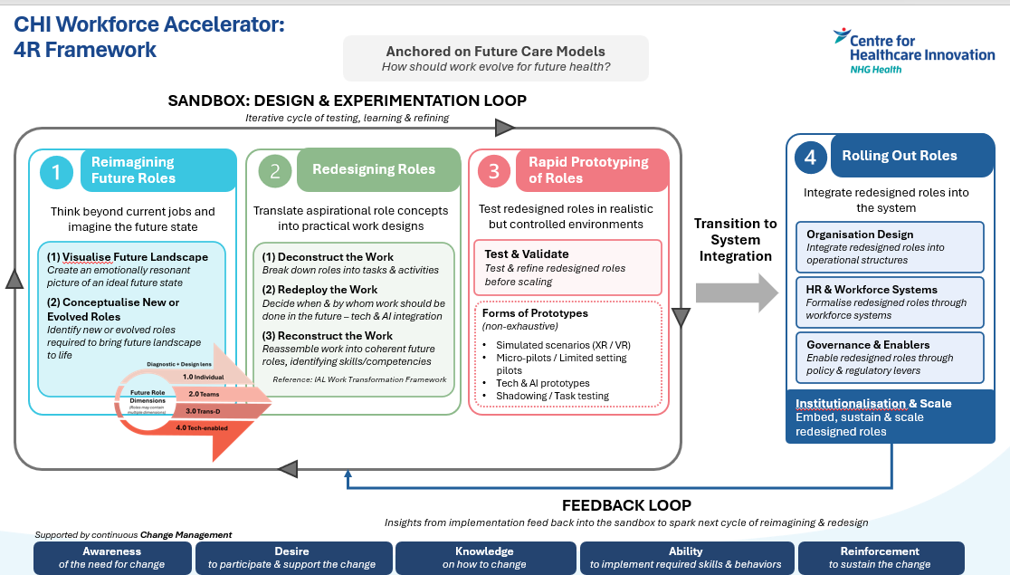
A key highlight of CHI INNOVATE 2026 is the launch of the CHI Workforce Accelerator hosted by NHG Health - Singapore’s first structured platform to support workforce transformation through job redesign, rapid prototyping, and cross-sector collaboration.
While workforce transformation is widely recognised as necessary, many organisations face challenges moving from concept to implementation. The Accelerator addresses this by combining scenario planning models with job redesign methodologies in a structured iterative process, enabling healthcare organisations and professionals to redesign roles and test new care models within a three-to-six-month timeframe; supporting transformation that improves care delivery today, while building readiness for the emerging needs of tomorrow.
Developed as part of CHI’s a co-learning network, the Accelerator is co-created with partners across the workforce, capability building and innovation ecosystem.
1.3 Building Workforce Capabilities for Sustained Transformation
Complementing the Accelerator, CHI continues to strengthen workforce capabilities through its academies and professional platforms - building on a decade of investing in people as the drivers of innovation and system transformation.
The Centre for Allied Health and Pharmacy Excellence (CAPE) and Centre for Asian Nursing Studies (CANS) equip healthcare professionals with the skills and frameworks to redesign roles, workflows, and teams, while community initiatives build capabilities among volunteers and caregivers to support a more distributed model of care. These efforts are reinforced through close collaboration with professional advocacy groups, enabling the real-world sandboxing of emerging care models, job roles, and skills, and strengthening the system’s ability to adopt and sustain workforce transformation at scale. Together, they empower healthcare professionals to take greater ownership of their development – driving workforce productivity and well-being across the sector.
2. Strengthening Partnerships for System Transformation
CHI INNOVATE 2026 will also unveil new and expanded strategic partnerships on workforce transformation across the healthcare ecosystem. Within NHG Health, this is anchored by NHG College and NHG Group HR, ensuring transformation is sustained and scaled through workforce capability building and leadership development.
CHI’s longstanding partnership with the Healthcare Academy and Healthcare Services Employees’ Union (HSEU) continues to drive workforce innovation through the Workforce Accelerator, supported by the NTUC Company Training Committee (CTC) grants to make job redesign more accessible and scalable. With impact already visible, including Tan Tock Seng Hospital (TTSH)’s smart rostering system highlighted at the recent May Day Rally, CHI and HSEU will expand the use of the CTC Grant to scale job redesign efforts across the sector.
CHI INNOVATE 2026 also marks the launch of several new strategic collaborations that extend CHI's reach across sectors and geographies. With GovInsider, CHI will co-create thought leadership content to amplify healthcare innovation insights across government and industry audiences. With Guy's and St Thomas' NHS Foundation Trust (GSTT) in the UK and the Health Sciences Authority (HSA), CHI will advance clinical AI leadership development and responsible AI adoption, drawing on NHS implementation experience and deepening governance frameworks for AI in healthcare settings.
CHI's partnership with the Institute for Human Resource Professionals (IHRP) will advance job redesign capabilities through the co-creation of a Healthcare-focused Job Redesign Playbook, Workforce Accelerator, and capability pathways. With SG Assist, CHI will extend volunteer and caregiver transformation efforts within NHG Health's community, strengthening the informal workforce for the future of care. Finally, a collaboration with Southcentral Foundation in the USA will support systems-level learning on population health and integrated community care, drawing on the Foundation's pioneering Nuka System of Care.
3. Building an AI-Ready Workforce for Healthcare Transformation
3.1 Advancing Agentic AI as a Digital Co-Worker in Healthcare
CHI will highlight efforts to advance agentic AI as part of workforce transformation, exploring how AI agents can support healthcare teams in redesigning routine work, coordinating tasks and testing new models of care.
As part of this effort, NHG Health is developing a consultation paper on the role of agentic AI in the future workforce, inviting healthcare, technology and other partners to collaborate on how agentic AI can augment healthcare teams, reshape workflows and support sustainable workforce transformation.
To translate this potential into practice, CHI is building an innovation ecosystem that gives healthcare staff practical pathways to test, build and scale digital and AI-enabled solutions. This includes CHI’s existing Digital Innovation Studio partnership with Amazon Web Services (AWS), which supports capability-building, technical advisory, architecture guidance and coordinated prototyping across NHG Health.
CHI will expand this ecosystem through its partnership with Microsoft to establish an AI Landing Zone in July 2026. The AI Landing Zone will provide a dedicated safe testing environment for healthcare staff to prototype and test agentic AI solutions using Microsoft AI tools before wider adoption. Microsoft will also provide training and technical guidance to help healthcare teams translate use cases into solution designs that are fit for clinical and operational settings.
3.2 Building Clinical Leadership Capability for AI Workforce Transformation
As AI moves from pilots and prototypes into clinical workflows, healthcare institutions will need clinicians who can lead, from identifying opportunities to safe implementation – from evaluating safety and value, to governing responsible use, redesigning workflows and deploying AI into practice.
To build this capability, CHI will introduce the CHI Clinical AI Fellowship, hosted by NHG Health in partnership with Guy’s and St Thomas’ NHS Foundation Trust and the Health Sciences Authority.
The Fellowship will develop clinical leaders who can combine clinical judgement with AI fundamentals, regulation, evaluation, workflow integration and digital transformation to guide safe and effective implementation in real healthcare settings.
Together, these efforts connect strategy, innovation support, access to the right technology and clinical leadership capability as part of NHG Health’s broader effort to develop agentic AI as part of the future healthcare workforce - setting a shared agenda for collaboration, enabling structured testing, and building the capability needed for responsible adoption in healthcare.
4. VirtCHILL: Leveraging XR technologies for Accelerated Learning & Stronger Capability Development
The “Virtual CHI Living Lab” (“VirtCHILL”), which will also be launched at the conference, is an Extended Reality (XR) platform that supports workforce transformation through immersive training, simulation and education. Conceived as a space by XR innovators for XR innovators to co-create, VirtCHILL brings together industry and academic partners to develop XR solutions that enhance experiential learning and enable rapid prototyping of new workflows in a safe, simulated environment.
VirtCHILL has already established strong collaborative partnerships. It will work with the Lee Kong Chian School of Medicine (LKCMedicine), bringing together NTU faculty and NHG clinicians to advance XR projects aimed at enhancing medical training and care delivery.
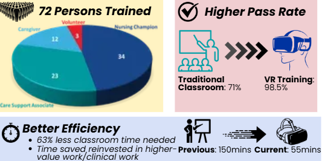
Another example is a joint initiative between Nanyang Polytechnic (NYP) and the Institute of Mental Health (IMH), which developed the “VR Simulation Training for Code Blue Emergency Resuscitation” – combining NYP’s technical expertise with IMH's clinical knowledge to enable staff to practise realistic, simulated scenarios on demand.
5. National Recognition of Innovation and Workforce Transformation
The National Healthcare Innovation and Productivity (HIP) Medals celebrates its 10th year in 2026, marking a decade of recognising excellence in healthcare innovation and productivity across Singapore's public, community, and private healthcare sectors. The National HIP Medals recognises leading innovations across the healthcare system, spotlighting efforts in care redesign, automation, and workforce transformation.
This year’s winners demonstrate how innovation is translating into real-world impact. Notably, the Excellent Champion award for Note Buddy: Ambient AI Scribe, recognised for its strong cross-cluster collaboration, highlights how AI-enabled solutions are transforming healthcare workflows, with adoption and scaling across institutions.
Workforce transformation is further exemplified by award-winning projects such as Nursing Vanguard of Caregiving Support and Project DEFEND: Digital Evolution of Foot Education in Diabetes, showcasing how job redesign, new roles, and digital tools enable healthcare professionals to deliver care differently and more effectively.
Together, these innovations reflect the broader shift towards a future-ready workforce, where technology, capability-building, and new care models are integrated to support sustainable transformation across the health system.
Professor Joe Sim, Group Chief Executive Officer, NHG Health, said, "Transforming our workforce is necessary to meet the demands of healthcare tomorrow. It is about ensuring our healthcare professionals are well-equipped with the skillsets and toolsets, and taking agency to reimagine the future of health, and redesign their work."
Looking ahead, as Singapore advances its shift towards preventive care and population health, the National HIP Medals will place focus on innovations that support these priorities. More will also be done to help proven solutions achieve wider adoption — through targeted funding and by connecting teams to opportunities for scaling their work across the healthcare system.
Enclosed:
Annex 1: List of 36 Reimagined Job Roles
Annex 2: The CHI Workforce Accelerator provides a four-stage platform to operationalise workforce transformation
Annex 3: The CHI Workforce Accelerator’s full list of partners
Annex 4: Case Studies
Annex 5: List of National HIP 2026 winners and their projects.