
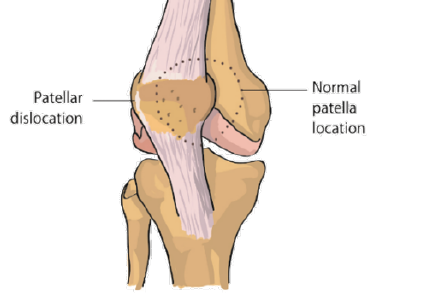
The patella is a flat triangular bone that lies in the front of the knee (kneecap). The patella is held by ligaments and muscles in the groove on the thigh bone. Patella dislocation, or dislocation of the kneecap, occurs when the patella moves out of its groove.
Additional Resources
How is Patella Dislocation Diagnosed?
- X-rays: To confirm dislocation and check if there are any fractures at the inner region of the kneecap
- Magnetic Resonance Imaging (MRI): To look for fracture within the joint and to assess the severity of the injury
- CT scan: To look at patella tracking and abnormalities to the bone alignment
Treatments
- Acute Treatment
The patella often relocates itself spontaneously after an episode of dislocation. If it does not, your doctor may have to manually put the kneecap back into the groove. Rest, Ice, Compression and Elevation (RICE) helps to reduce pain and swelling.
- Immobilisation
After putting the patella back in place, the knee is immobilised in a backslab or knee brace. The period of immobilisation can vary between 2 to 6 weeks depending on the severity of the injury.
- Medications
Pain-relieving medications, including non-steroidal anti-inflammatory drugs are often prescribed to reduce pain and swelling.
- Physiotherapy
Most patella dislocations or subluxations (partial dislocations) are effectively managed with physiotherapy to strengthen the quadriceps muscles.
- Surgical Treatment
If the initial injury produces a loose piece of bone and/or cartilage, surgery may be required to remove or fix the fragment. This may be performed by mini-open surgery or by arthroscopic "key-hole" techniques.
- Surgical Options for Recurrent Knee Instability
Some patients will develop recurrent patella dislocations after the first episode. If non-surgical treatment fails and the patella continues to slip out of the groove, surgery would then be recommended to stabilise the patella.
Surgeries can be broadly divided into soft tissue procedures and bony re-alignment procedures. Your doctor will advise you on the most ideal type of surgery.
Common Surgical Options
- Medial Patello-Femoral Ligament (MPFL) Reconstruction:
It involves taking one of your inner hamstring tendon or from a tissue bank and joining it onto the patella to recreate the torn ligament.
- Release Tight Lateral Patella Tissue
- Tibial Tuberosity Bony Transfers
This may be necessary if patient has significant bony deformity resulting in dislocation of the patella.

