Impact PreSAGE
Stay Safe, Stay Private: Fall Prediction Technology that Hospitals can Trust
Technology experienced exponential growth during the 1980s, characterised by inventions such as the transistor, the laser, the computer, the internet and finally the mobile phone. Today, these inventions can be seen in our inpatient wards in the form of electronic health records, health monitors and smartphones, used for the monitoring of patients’ health and the digitalisation of repetitive and mundane tasks.
As technology continues to advance, one can wonder, what would be useful for the future of our wards? An emerging technology appears to be the invention of predictive analytics, which enables healthcare providers to predict a patient’s condition before it worsens, allowing case prioritisation and care optimisation. A review of current innovation projects will quickly reveal the growing interest of predictive analytics, with numerous clinicians trying to prove their hypotheses on predictive models and sensors, and then driving to implement the solutions into our wards.
A technology that made its way into the single-bed and isolation wards of Tan Tock Seng Hospital (TTSH) is the PreSAGE® Fall Prediction System, co-developed by TTSH Nursing Department and CoNEX Healthcare Pte Ltd. The system utilises thermographic sensors, image processing and predictive algorithms techniques to detect imminent bed exits, which allows a 15s lead time for caregivers to intervene. Its privacy-preserving, round-the-clock monitoring and informative dashboard makes it an attractive solution to enhance the performance of the ward while safeguarding patients’ data. The evaluation study of PreSAGE® reported 42% reduction in falls and 67% increase in manpower efficiency, demonstrating the potential of predictive analytics in our healthcare system.
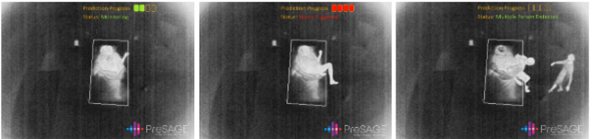
Similar to how the development of computer paved ways to the development of internet, the start of bedside prediction will pave way to more beneficial applications of thermographic sensors. PreSAGE® is exploring its applications to further optimise ward activities, such as the use of sensors in multi-bed wards, the tracking of activity and health status against time to detect health deteriorations for early interventions.
In our society shaped by rapid technological advancements, healthcare innovations should leverage these technologies to create a more agile workforce ready to meet the demands of an aging population. Ultimately like PreSAGE®, healthcare innovations that directly addresses the clinical needs will be integrated into the hospitals, creating a futuristic place that supports care delivery.

